


Expert guide · Accuracy
How accurate are people counters, really?
Every vendor publishes a number and almost none of them says what it measures. A published accuracy figure is the vendor’s count checked against the vendor’s own rules, on a sample of footage a team sat down and audited — not a continuous measurement of your door. That does not make it worthless. It makes it a different thing from what most buyers think they are reading. Here is where the number comes from, what it quietly excludes, how to check your own counter with arithmetic you can do in a spreadsheet, and what to ask before you believe anybody, ourselves included.
Published by SMS Storetraffic. We sell people counters and publish our own accuracy figures, so we have a stake in how you read this. Everything here that is ours is labeled and linked to our help center, where you can check it.
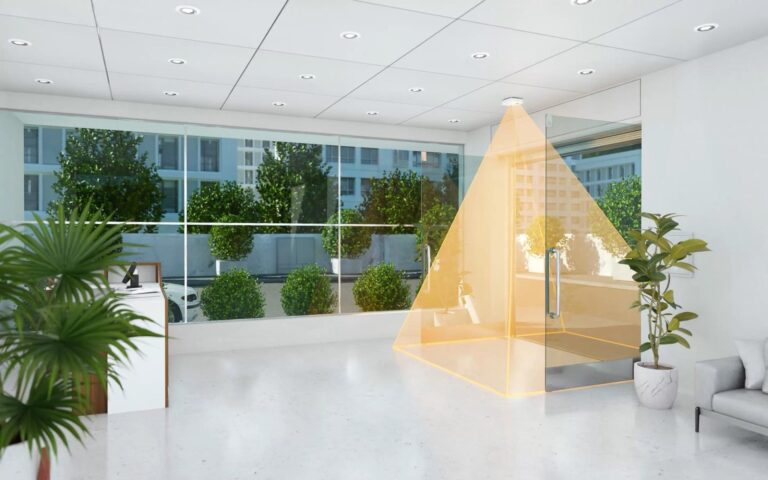
The counter that can show you its own work — 3D Scope II LC
The short answer: a good people counter installed properly counts 95–99% of adults, and the figure is real. But it is measured against the vendor’s definition of what should have been counted, on audited sample footage, not on your door in perpetuity. The useful questions are what the rules were, what minimum the vendor will stand behind, and whether you can verify it yourself. All three have answers. The percentage on its own does not.
Where it comes fromA team audits sample recordings against the vendor’s counting rules and reports a figure. Nobody reviews every video — that would mean paying people to do by hand the exact job the sensor exists to do.
The rules are half the numberMost counters are tuned to count adults: anything above a height threshold with roughly the right shape. Change the rules and the same sensor produces a different percentage. Agree on them before anyone audits anything.
A ceiling is not a floor“Up to 99%” is the best result a vendor has seen. “Below 95% on a 30-minute audit of a busy period, at any time in the first two years, and we fix it” is the minimum you are agreeing to accept. Only the second one is a commitment.
You can check it yourselfIN and OUT should nearly balance over a full day at a normal entrance. The gap between them, divided by the total, is a free and continuous health check — the formula and a worked example are below.
What we publish, and don’t3D Scope II LC: 99%+ on adults at best, 98% typical, 95% floor guaranteed for two years. PEARL: upwards of 98% on adults walking through normally, one at a time. We publish no figure for children and none for groups, on purpose — why.
The machinery behind the percentage
Where an accuracy figure actually comes from
No vendor watches all the video. That is worth saying plainly, because the phrase “99% accurate” implies somebody somewhere is continuously checking. Continuous checking would mean streaming every door to a server and paying people to watch it — which is precisely the job the sensor was bought to eliminate. Any vendor doing that would be running a very expensive manual counting service with a sensor bolted to the front of it.
What happens instead is an audit. A team records sample footage from real installations, counts it by hand, compares the hand count with the sensor’s count, and publishes the result. That is a legitimate method — it is how you measure any instrument — and it has two consequences most buyers never hear about.
First, the figure comes from many audited installations. It holds at your door when the sensor suits that entrance and is installed as the vendor specifies.
Second, the hand count is itself a judgment. Somebody had to decide what counted. That decision is the part of the number nobody publishes, and it is the subject of the next section.
Definition
People counter accuracy is the proportion of qualifying crossings that a sensor records correctly, measured against a defined counting rule over an audited sample. It is a property of the sensor, the installation and the rule together — not of the sensor alone.
The half nobody publishes
The counting rules are part of the number
Most counters are tuned to count adults. In practice that means anything taller than a height threshold with roughly the right shape from above. That is already a proxy, and in retail it is a proxy for something else again: the point was never to exclude children, it was to exclude people who cannot buy. The proxy holds right up until a ten-year-old is as tall as an adult, which happens constantly.
Group counting has the same shape of problem. The sensor assumes that people arriving together, spaced similarly, moving along the same path and with their heads pointed the same way, are one party. That is a reasonable heuristic and a useful indicator. It is not knowledge. A couple who walk in ten feet apart are two parties; two strangers who arrive at the same moment are one. No algorithm resolves that, because the information is not in the scene.
Which is why two counters can both be “98% accurate” and disagree about your door by a wide margin. They were measured against different rules.
Our position on this We publish an accuracy figure for adults and deliberately publish none for children or for groups. Both are genuine features of the 3D Scope II — it reports children separately and it groups parties — and both work well enough to be useful. The line between the two is measured, not guessed: by default the sensor classifies anyone under 130 cm (51.8 in) as a child, from measured height and shape, and that threshold is configurable. A height measured from above is not exact to the centimeter — it is typically within 5%, which puts the effective line between about 49 and 54 in, close to the 54 inches at which a beam is mounted to count adults only. What makes a child figure hard to stand behind is what happens below that line — small targets are hidden by taller people, walk very close to them, or move alongside a stroller or cart. Very small children can also go uncounted on purpose. To keep adult counts accurate, the sensor has to ignore low objects such as carts, strollers and bags, so when a small target is not close to certain to be a person, it plays safe and leaves it out. That is why we present children as a trend rather than a precise count. And two people watching the same doorway would not agree on where a group starts, which means a group-accuracy percentage could never be audited against anything. We would rather ship the feature and decline the number than publish one we could not defend.
So the first thing to establish with any vendor, including us, is the rule set. Five questions settle it:
Are children counted, and from what height?
A fixed height threshold is honest and blunt. On-device AI can sort by shape as well as height, which does better with tall children and short adults, but it is still a judgment the vendor made for you — unless you can change it. On the 3D Scope II the threshold is configurable, with 130 cm (51.8 in) as the default.
Is staff excluded, and how?
Most businesses do not need this. If your traffic is healthy, staff movements are part of a stable pattern and wash out of every comparison you care about. It matters where the ratio is extreme — a jeweler with low traffic, high value and four people on the floor — and there it is worth the extra thing to manage. Our own approach uses UWB tags, which exclude a wearer without identifying anyone, and can optionally record staff crossings as a separate count, outside the normal adult count.
What happens to someone who steps in and straight back out?
A U-turn inside the field of view should be recognized and canceled by a 3D sensor. A beam will record it as an entry and an exit, which is arguably correct and definitely different.
What happens to someone who stands in the doorway?
The hardest case for every technology. A person who lingers on the line can be counted twice, or, under a thermal sensor, put the in and out counts out of step. A 3D sensor tracks them as one object as long as they stay in view to avoid that.
Are carts, strollers and wheelchairs counted?
A wheelchair user is a person and should count. A cart is not, and a sensor built for retail can tell the two apart and count carts separately: our 3D Scope II LC detects and counts carts, and treats a baby stroller or an empty wheelchair being pushed as a cart too, while the person pushing it is counted. These are the cases that separate a sensor that was designed for retail from one that was adapted to it.
Read the sentence, not the number
A ceiling is not a floor
“Up to 99%” and “never below 95%” look like the same kind of statement and are opposites. The first is the best result a vendor has seen and commits them to nothing. The second is where an audit is required, and it only means anything if the vendor also says how it will be verified and what happens when it is missed.
Most of the market says “up to”. Of the eight vendors in our nine-system comparison, three put a floor in writing: SenSource guarantees 98%, RetailNext 95% after installation (in an archived post; its live site says 95–99%), and SMS Storetraffic 95% on the 3D Scope II LC for two years, verified by video audit. The rest publish a ceiling, a condition-based range or no figure at all.
| What the vendor says | What it commits them to | What to ask next |
|---|---|---|
| “Up to 99% accurate” | Nothing. It is the best observed result. | “What is the minimum, and what happens if mine is below it?” |
| “99.8% accurate” | Nothing, and the extra decimal is a marketing decision. No counting rule is defined to a tenth of a percent. | “Measured against which rules, on how many passes?” |
| “Industry-leading accuracy” | Nothing, and there is no number to check. | “What is the figure, and where is it published?” |
| “95% minimum, guaranteed two years, verified by video” 3D Scope II LC | A floor, a period and a method. It can be tested and it can be failed. | “Show me the audit procedure.” Here it is. |
A floor is only as good as the remedy attached to it. Ours is recalibration, remotely where possible, and replacement where not. Ask what the remedy is before the number impresses you.
The part the datasheet leaves out
Consistency is accuracy that holds
An accuracy rating is measured under particular conditions and rules. What it cannot tell you is how the counter behaves on every other kind of day, so you still have to factor in consistency. A sensor rated at 98% that is thrown off whenever sun floods the entrance will read 98% most of the time and far less for those hours — and once one period is measured differently from another, you have lost the comparison, which is the reason you count at all.
Get that right and a small, steady error is harmless. A counter that misses the same small share of people every day still tells you the truth about your trends: your Saturdays are still bigger than your Tuesdays, this September still compares with last, and every ratio built on it holds.
The other half of consistency is not missing time. A counter that records nothing for an afternoon has not made a small error; it has made a hole. Every technology has conditions that knock it off, and every system has ways to lose time. Ask about each one before you buy. Here is how ours answer.
| What breaks consistency | Ask any vendor | How ours handle it |
|---|---|---|
| Sun on the entrance | How does it count with direct sun on the door, and across what width? | PEARL keeps counting in direct sun across entrances up to 7 ft (2.1 m), which covers most single and double doors. The 3D Scope II’s HDR sensor handles bright and backlit entrances, and because it measures depth it ignores shadows. |
| Busy entrances | Does it separate people walking side by side? | The 3D Scope II does. PEARL counts single file, which is how most single and double doors are used anyway: a door slows the flow and narrows the opening, so people come through one at a time, and a double door is rarely used as two lanes at once, so the count stays steady. For a wide and very busy entrance where people arrive side by side, we recommend the 3D Scope II. |
| Obstructions | What happens if something ends up in the sensor’s way? | On a door frame this almost never happens: nobody puts a display in a doorway, and people don’t stand in one while others pass. At an open mall entrance it can. A table, banner or mannequin placed on the lease line can block a beam outright, or make people weave across it and be counted twice. If the beam is blocked, PEARL emails you within minutes. Displays also make people stop, and a thermal counter can lose a shopper who stands still long enough, then count them again as they move on. If displays at your entrance come and go, a stereo, time-of-flight or video counter looking down from the ceiling, such as the 3D Scope II, is the safer choice: it keeps tracking someone who stops for ten seconds at a table. |
| Darkness | Does it need light? | PEARL doesn’t: a beam brings its own light. The 3D Scope II needs about 3 lux; below that, choose a sensor that brings its own light. |
| Network or server outage | Does it store counts while offline and resend them? | PEARL and the 3D Scope II both keep their counts through an outage and send them when the connection returns. |
| Links in the chain | How many devices sit between the door and the report? | PEARL and the 3D Scope II both connect straight to your network, with no recorder in between. Every extra device — a camera and its recorder, a sensor and its gateway or cellular box — is one more thing that can stop the counting. |
| Batteries | What warns you before they die, and what happens to the counts? | PEARL emails a low-battery alert and keeps storing counts for a while after it stops reporting. The 3D Scope II has no battery at all: it is powered over Ethernet (PoE), so there is nothing to change. |
When you change counters Expect the numbers to move. A new counter can show more or less traffic from the day it goes in, and your conversion rate moves with it — but your sales have not changed at all. Tell your team before it happens: traffic is the measured side of the ratio, sales are what they are, and every figure built on the count simply starts from a new baseline. Compare forward from the switch date rather than across it. A chain that needs to restate years of history can run the old and new counters side by side for a couple of weeks to get the conversion factor; for most stores, a clean new baseline is enough.
The thing you are actually buying
What you can verify matters more than what you are told
Every accuracy figure is somebody’s word. Trust in a count matters, and it is strongest when you can see it for yourself: watching the sensor count real people at your own door, rather than taking a number on faith. What separates the technologies is not how loudly they claim, but how easily you can check. That difference is physical, not commercial, and it is the single most useful thing to understand before choosing.
| Technology | What you can see | How strong that is | When it matters |
|---|---|---|---|
| Infrared beam PEARL | Nothing — but you do not need to. Walk the line and watch the light: one green blink per IN, one red blink per OUT. Other blink patterns flag an issue (light codes). | Self-evident. Anyone can do it in five minutes with no tools. | Any dispute. Free and immediate: no tools, no vendor. |
| 3D stereo vision 3D Scope II | A live view of what the sensor sees, and a recording with the count line, the tracked person and the detection area drawn on top. | Settles an argument. You can point at the exact crossing that was missed. | Busy entrances, groups, anywhere the count is contested. |
| Time-of-flight | A live depth view: a silhouette with head and shoulders clearly made out, no face, no color, no clothing. | Shows the sensor is working. Does not show what crossed — a silhouette is person-shaped, which is not the same as a person. | Good enough for installation checks; thin for a disputed count. |
| Overhead thermal | A low-resolution heat map. Warm shapes on a cooler floor. | Weakest. A shopping cart left in the sun looks like a warm body, and a customer watching a recording of blobs has no way to be sure. | Hard to settle anything. Weigh this against thermal’s real strengths. |
None of this makes thermal a bad technology. It counts in total darkness, it forms no recognizable image of anyone, and it can run on batteries — which for a site with no network and no cable can be the difference between counting and not counting. Those are genuine advantages and we say so on our technologies page. Verification is simply the place where it is weakest, and the industry knew it: Irisys, once the largest thermal people-counting vendor in the world and now out of the market, ended up fitting optical cameras alongside its thermal sensors for no reason other than letting customers confirm the counts were people. One video-equipped unit could serve several thermal-only ones. Nobody adds a camera to a privacy-first product for fun.
Arithmetic you can do today
Check your own counter: the IN/OUT balance
At a normal entrance, everybody who comes in eventually goes out. Over a full trading day the two totals should nearly match, and the gap between them is a free, continuous health check that needs no video, no vendor and no appointment. It is the first thing our support team looks at on a 3D Scope II, and it is the easiest thing for you to look at too. A depth sensor that is working is very accurate in both directions, so a large gap that lasts is usually a good hint that something needs adjusting.
The arithmetic:
Accuracy = [ 1 − ( |IN − OUT| ÷ (IN + OUT) ) ] × 100
Worked example. A day closes with IN = 100 and OUT = 95. The discrepancy is 5 and the total number of counted events is 195, so the error ratio is 5 ÷ 195 = 0.0256, and the health check reads 97.44%.
Read it over the last 14 days, not over one day. That is how our support team reads it: anything above 95% across two weeks is good, and we aim higher — a healthy installation typically reads around 98%. A single day can read low for reasons that have nothing to do with the sensor, such as a side door opened for a special event that no counter watches, and a rolling two-week window lets those days pass without a false alarm while still showing a real drift. Below 95% over two weeks, raise it: on a 3D Scope II LC inside the guarantee, that is our problem to fix, not yours to live with.
How to read it.
One low day is not a fault. A difference of two to five counts over several hundred is ordinary margin of error, and an unusual day — an event, a delivery through the front, a second door propped open — can move it further. What matters is a gap that stays wide across the two weeks, or keeps growing.
A gap does not always mean the counter is off. The most common cause is staff who come in through the front and leave through a back or staff door that is not counted. Some entrances are unbalanced by design: a cinema where everyone enters through one door and leaves through another, a venue that opens a second exit at the end of the night or a side door for a special event, a shopping-center unit whose customers cut through to the mall. There, check the balance across the whole site, not the single door.
When a gap lasts, we audit and adjust. We review a recording of the entrance and look for a calibration or configuration setting to change. A typical example is a count line drawn too close to the entrance: the sensor needs room to pick a person up before they reach the line — at least 2 ft (50 cm) on each side (calibration guide) — and when one side has less, that direction counts less accurately. Moving the line fixes it. The full method, with a calculator, is in our help center: measuring accuracy when IN does not equal OUT.
What the guarantee covers. The 95% floor covers the sensor where it was installed and calibrated. If the entrance is rebuilt or the sensor is moved, it needs recalibrating for its new surroundings, and that is outside the guarantee. On top of it, every counter comes with our 30-day money-back guarantee: we want it to work at your door, and if it does not, you are not stuck with it.
Where this check is silently wrong A balanced IN and OUT is evidence, not proof. A counter that misses the same person on the way in and on the way out reads as perfectly balanced while undercounting the day. This is why the balance check is a first health check — cheap, continuous, good at catching the failures that actually happen — and why a video audit is what settles a question about the absolute number.
The unglamorous truth
How a vendor actually notices your sensor is wrong
Not by watching video. By watching for data that does not make sense. We publish this because we have not found a competitor that does, and because knowing it tells you what to expect from whoever you buy from.
The IN/OUT balance drifts
The check above, run on our side rather than yours. A location whose two totals stop agreeing gets investigated. We use roughly a 5% divergence as the point where a location is worth looking at, and we read it over the last 14 days rather than a single day — ordinary daily variation will cross any threshold occasionally.
A value sticks out
Zero counts during trading hours. A thousand counts against a pattern that has never exceeded two hundred. A door that reports identical totals three days running. These are cheap to detect automatically and they catch real failures — a dead sensor, a stuck device, an interference source that appeared overnight.
The pattern breaks its own shape
Traffic has a shape: a weekly rhythm, a daily curve, a relationship to your opening hours. A counter that is drifting can bend that shape before it changes the total. This is harder to catch than a value that sticks out, because real traffic has exceptions too — a holiday, a storm, a sale — but it is one of the signs we watch for.
The customer says the numbers make no sense
Still the most common trigger. You know your store: if a Saturday reads like a Tuesday and it did not feel like one, say so. More often than not the count holds up and the surprise is the number itself — a conversion rate lower than anyone expected is the usual one — but we take every report seriously. We check the other signs above and, where they point to a problem, run an audit.
How a dispute ends
The 30-minute video audit
When the question is “is this number right”, the answer is a recording, not an argument. The procedure below is ours; the shape of it should be available from any vendor selling a camera-based counter, and if it is not, that tells you something.
Record 30 minutes at a genuinely busy time
Recorded from the counter’s own video menu. A quiet half hour tells you little. A busy one puts every situation in front of the sensor — groups, people side by side, someone pausing in the doorway — and with that much to look at, it is easy to see what, if anything, is causing an inaccuracy. Recordings run up to 60 minutes and are stored in 30-minute segments.
Open it with the overlays turned on
In the player, enable Count Line, People Track and Floor Area. Now you are not watching video, you are watching the sensor think: where it drew the line, what it tracked, and which part of the floor it was told to care about.
Count by hand and log every event
On the audit worksheet, one line per crossing, marking the ones the sensor got wrong. This is the tedious part and it is also the whole point — it is the same method the published figure came from, run on your door instead of a sample.
Do the arithmetic
Accuracy is (total events − failed events) ÷ total events. Above 95% meets the guarantee; a healthy installation typically reads around 98%. Below 95% is where the next step applies.
Fix, then re-audit
Below the floor, the cause is nearly always placement or calibration: a display too close to the line, a door swinging into the detection area, a height setting that does not match the entrance. Most are corrected remotely. The second recording proves whether the correction worked, which is the part an argument can never do.
Support reviews your account data first — traffic trends, calibration, the IN/OUT balance — and runs the full audit if that review suggests a problem. Audits may carry a service fee once the counter’s warranty period has expired. The full written procedure, including the worksheet, is here: how to audit your 3D Scope II traffic counter.
For a beam counter there is no video and none is needed: stand at the door and walk through it twenty times. Our own repeat testing of a properly installed PEARL runs at zero to two errors per hundred passes, and those are usually a direction called wrong rather than a person missed — which partly cancels, because a wrong IN tends to be matched by a wrong OUT.
Across a chain
How do you check counter accuracy across 30 stores?
Screen every store with the same 14-day IN/OUT balance, send only the stores below 95% to an audit (30 minutes of video, or the walk test for a beam counter), and hold every door to the same counting rules. The rules matter because stores are compared: on identical sales, a store counting 90% of visitors shows a conversion rate about 9% higher than one counting 98% (0.98 ÷ 0.90).
- Agree one set of counting rules for every door (children, staff, U-turns, carts), using the five questions above.
- Pull every store’s IN/OUT balance for the same 14 days and judge each against 95% (the floor two of the three written guarantees use): a fleet averaging 97% can hide one store at 89%.
- Set aside doors unbalanced by design, such as an uncounted staff exit, and check those across the whole site.
- Audit stores still below 95%: record 30 minutes at a busy time, count by hand, fix the cause, record again. Beam counters: the twenty-pass walk test.
- After a refit, a moved sensor or a new counter, recalibrate and compare that store forward from the date.
SMS Storetraffic’s support team reads the same 14-day balance on its own installations and investigates a location at roughly a 5% divergence. Ask any vendor whether it flags a drifting store or leaves you to pull each report.
Before you believe anybody
Seven questions that separate a measurement from a slogan
What is the guaranteed minimum, and for how long?
Not the maximum. If the answer is a ceiling with no floor under it, you have been told the vendor’s best day and nothing about yours.
What were the counting rules?
Children, staff, U-turns, carts, doorway lingerers. A vendor who has thought about accuracy will have a ready answer. A vendor who has only thought about marketing will give you the percentage again.
How do I verify it on my own door?
Walk the line, watch a live view, record a clip with overlays. Any of those is fine. “Trust the datasheet” is not.
What happens when mine reads 91%?
The answer reveals whether the guarantee is a commitment or a sentence. Recalibration, replacement, a refund and a timeframe are commitments.
Does the figure apply to my entrance?
Width, door type, lighting, ceiling height, whether people arrive in groups. A number measured on a single-file office door does not transfer to a twelve-foot mall entrance at Christmas.
Will you show me the audit procedure before I buy?
This is the question that cannot be answered with adjectives. Ours is published. Ask for the equivalent and see what arrives.
Does your support documentation say the same thing as your marketing?
Help-center articles and installation guides are written for the people who have to make the product work, and they are where the caveats appear: which doorways, which mounting heights, what happens with groups. If they say something different from the marketing, believe them.
A last thought on why the figures exist at all. A television’s contrast ratio is measured on a full-black screen at the darkest setting and a full-white screen at the most vivid one — a real measurement of a situation nobody will ever watch. It is still not nothing: it tells you the manufacturer was willing to be measured. An accuracy figure works the same way. What it actually says is “this will work, it will be consistent, and it will hold up if you audit it.” The vendors worth buying from will let you do exactly that.
Common questions
People counter accuracy: questions people ask
How accurate are people counters?
A well-installed 3D stereo or time-of-flight counter records 95–99% of adults crossing the line; an infrared beam records 95–98% of single-file adults and fewer when people walk abreast. SMS Storetraffic’s 3D Scope II LC is rated at 99%+ on adults, typically runs at 98%, and carries a written 95% floor for two years, checked with a 30-minute audit of a busy period.
What does “98% accurate” actually mean?
It means that when a team compared the sensor’s count with a hand count of sample recordings from many installations, the sensor agreed 98% of the time — against the vendor’s own definition of what should have been counted. Change the definition, for example by including children, and the same sensor produces a different percentage. The number is real; it is just a measurement of the sensor, the installation and the counting rule together, not of the sensor alone.
How do I check whether my people counter is accurate?
Two ways, and use both. Continuously and for free, compare IN with OUT over a full trading day: accuracy = [1 − (|IN − OUT| ÷ (IN + OUT))] × 100. Read it over the last 14 days rather than a single day, because an uncounted side door opened for one event can skew a day: above 95% across two weeks is good, a healthy installation typically reads around 98%, and below 95% needs attention. Definitively, record 30 minutes of video at a busy time with the count line and tracking overlays switched on, count it by hand, and compare. The video audit settles the absolute number; the IN/OUT check catches problems as they appear.
What is an acceptable people counter accuracy?
We treat 95% as the minimum acceptable and guarantee the 3D Scope II LC will not fall below it for two years. In practice a healthy installation reads about 98%, and above 99% is excellent. But consistency matters more than the last percentage point: a counter that catches 90% every day supports every trend and ratio you will build, while one that swings between 100% and 70% is useless whatever its average.
Do people counters count children?
It depends on how they are set up. An infrared beam mounted at 54 inches passes over most children by design; mounted at 24 inches it counts everyone. Overhead 3D and time-of-flight sensors measure height and can report children separately. We publish an accuracy figure for adults and deliberately publish none for children: the 3D Scope II classifies anyone under 130 cm (51.8 in), give or take 5%, as a child, but small targets are often hidden by taller people or move alongside a stroller or cart, so we present children as a trend rather than a precise count. The underlying reason retailers ask is usually not about children at all — it is about excluding people who cannot buy.
How accurate is group counting?
Group counting infers that people arriving together, spaced similarly, moving along the same path and with their heads pointed the same way, are one party. It is a useful indicator and it is not knowledge: a couple who walk in ten feet apart are two parties, and two strangers arriving at the same moment are one. Our 3D Scope II reports groups, and we deliberately publish no accuracy figure for it, because two people watching the same doorway would not agree on where a group starts — so there is nothing an audit could measure against.
Is a guaranteed 95% better than a claimed 99%?
Almost always, yes. “Up to 99%” is the best result a vendor has observed and commits them to nothing. “Below 95% on a 30-minute audit of a busy period, at any time in the first two years, and we fix it” is a floor, a method, a period and a remedy, and it can be tested and failed. Ask what happens when your counter reads 91%: the answer tells you which of the two you are being sold.
How accurate are thermal people counters?
Thermal door counters are documented at 85–95% on most doorways (one thermal vendor’s support documentation for its door sensor), below the 95–99% of 3D and time-of-flight sensors. That range is thermal sensing only, not battery-powered counters in general: an infrared beam, often battery-powered too, records 95–98% of single-file adults. The gap is physical: people entering in a dense group merge into one heat shape, and a low-resolution array loses detail the further it sits from head height. Thermal has genuine strengths — it counts in total darkness, forms no recognizable image, and can run on batteries — but it is also the hardest to verify: you are looking at heat blobs, and a shopping cart left in the sun looks like a warm body.
Can I trust a counter I cannot see through?
You can, if the vendor gives you another way to check. An infrared beam produces no image at all and is the easiest of all to verify: walk the line and watch the count. A time-of-flight sensor shows a live depth silhouette — head and shoulders visible, no face, color or clothing — which confirms it is working but not what crossed it. What you should not accept is a sensor with no image and no verification route, where the only evidence is the datasheet.
Check our work
Sources
Our own figures, formulas and thresholds come from our product pages and help center and are linked in place, so you can read them before buying rather than after. Statements about what other vendors publish are the result of reading their public product pages. Two current vendors are named for their written accuracy floors, and Irisys, which has left the market, for its history; their sources are linked below. Everything else is summarized without naming anyone. Named comparisons live on the comparison page.
Our accuracy figures and methods
- SMS Storetraffic — understanding people counter accuracy: how to measure it when IN ≠ OUT (the formula, the worked example, the seven causes, and the 98% typical / 95% minimum figures)
- SMS Storetraffic — how to audit your 3D Scope II traffic counter (30-minute recording, count-line overlays, the worksheet, and the grading scale)
- 3D Scope II LC installation and specifications; UWB staff filtering; PEARL specifications
Industry figures
- SenSource — accuracy methodology, “we guarantee 98% accuracy” (archived Sep 11, 2026)
- RetailNext — accuracy and audit process (archived copy; the live page has since been removed)
- RetailNext — Built for Retail: 95–99% accuracy, manual audit at go-live, 4–6 week deployment (archived Sep 29, 2026)
- Wikipedia — People counter (generational accuracy figures, including the 80–85% attributed to the thermal era; note the article gives no citation for them)
- Thermal accuracy range: vendor support documentation, checked September 2026 — 85–95% on most doorways, lower when people arrive in dense groups or the sensor sits far above head height; no figure on product pages.
- Irisys — “Irisys products are no longer available” on their own site (checked September 2026), with the Vector 4D end-of-life announcement linked from it. The Gazelle DualView’s optical camera for count validation is documented in its product literature.
Related reading
How this page was made
It exists because the accuracy section of our main guide kept growing. Everything here is either published by us and checkable in our help center, or the result of going and reading what other vendors say and reporting what is and is not there. Where we decline to publish a figure — children, groups — we say so and explain why, because a missing number with a reason attached is more useful than a number nobody could audit. Corrections via our contact page.
Keep reading