


Expert guide · Technology
People counting technologies compared: beam, thermal, 3D stereo, time-of-flight, AI video and Wi-Fi (2026)
Every sensor technology used to count people at a building’s doors, entryways and internal corridors, explained by how it detects a person — because that is what decides what fools it. With typical accuracy, mounting heights, power needs, privacy footprint and the entrance each one belongs on. Twenty years of installing and supporting all of them, including the ones we do not sell. Outdoor counting — trails, parks, open-air events — is a different job with its own equipment, and is not covered here.
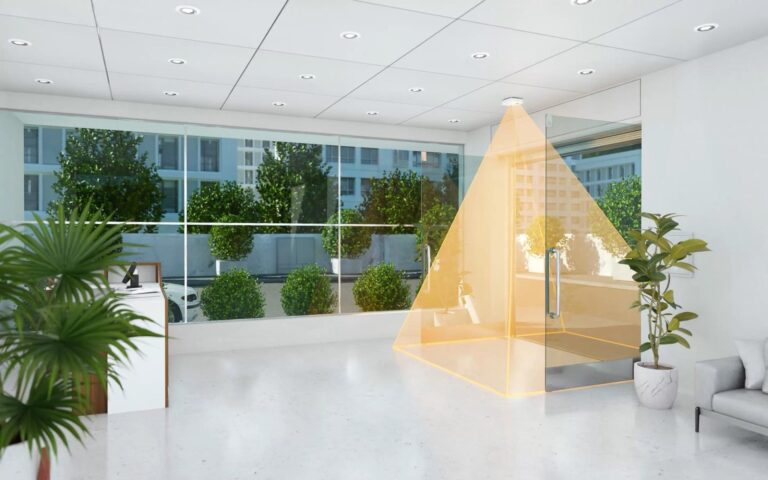
A 3D stereo sensor: two lenses, one height map, one PoE cable — the 3D Scope II LC
The short answer: in 2026 there are four technologies worth buying for a door — wireless infrared beams (cheap, simple, single-file only), overhead thermal (works in the dark, no image, weaker on crowds), 3D stereo vision (the accuracy leader for busy and wide entrances, needs a cable) and time-of-flight depth sensors (stereo-like accuracy with no color image at all). 2D video has improved sharply now that sensors run AI object detection rather than background subtraction, and sensors that listen for phone signals — Wi-Fi, Bluetooth or cellular — count devices rather than people.
Side by side
Every people-counting technology, compared
Accuracy figures are the ranges vendors publish for their own products under good conditions; the two sensors we sell, a beam and a 3D stereo sensor, are marked. We sell no thermal, 2D video or time-of-flight counter. Mounting heights are typical published ranges. “Privacy” describes what the sensor can capture by design, which is what matters legally, not what a particular installation is configured to keep.
| Technology | Detects | Typical accuracy | Side by side | Child / cart filter | Direction | Mounting | Power | Light / weather | Privacy | Hardware cost |
|---|---|---|---|---|---|---|---|---|---|---|
| Wireless infrared beam PEARL | Beam between two units broken | 95–98%, single-file adults | No — counts one | By mounting height | Yes, with two beams | Wall or frame, 54 in (adults) / 24 in (all) | Battery | Direct sun shortens range; indifferent to darkness | No image possible | $100–$500 |
| Overhead thermal array | Warm shape tracked against a cooler floor | Typically 85–95% | Yes, until shapes merge | Inferred, not measured | Yes | Top of the door frame, up to 3.6 m (12 ft) | Battery or wired | Works in total darkness; heaters and sunlit floors can confuse it | No recognizable image | $300–$800 |
| 2D mono video | A single lens; modern units run on-device AI object detection, older ones moving pixels against a learned background | 80–95% for older units; AI models claim 95–98% | Improving with AI | By appearance rather than height | Yes | Ceiling | Wired (PoE) | Much improved by AI and WDR; low sun and hard shadows remain the hard case | Images; on-device anonymization on good systems | $200–$700 |
| 3D stereo vision 3D Scope II LC | Two lenses compute a height map; heads tracked as objects | 95–99%; some vendors guarantee a floor | Yes | Yes, by height and shape | Yes, multiple lines | Ceiling, ~2.2–6 m; high-mount models to 20–25 m | Wired (PoE) | Needs ~3 lux; HDR handles glare | Depth on device; video off by default on good systems | $300–$1,200 (most $650–$1,200); outdoor and specialized to ~$2,000 |
| Time-of-flight / LiDAR | Timed infrared pulses give a depth map | 95–99% | Yes | Yes, by height | Yes | Ceiling, typically 2.5–5 m | Wired (PoE) | Works in darkness; daylight degrades it, and by how much varies widely between units | Depth silhouette; no face, color or clothing | $500–$1,200 |
| Wi-Fi / Bluetooth sniffing | Phones, watches and other devices broadcasting nearby | Counts devices, not people; randomization made it much harder from 2015 | Counts devices | No | No | Anywhere in range | Wired | n/a | Device identifiers; personal data under many privacy laws | $100–$500 + platform |
| Pressure mats, turnstiles, door-swing counters | Weight on a mat; a barrier turn; a door opening | Turnstiles ~100% per turn; mats and door counters low | No | No | Turnstiles yes | Floor / gate / door | Varies | n/a | No image | Wide range |
Sources are listed at the end. Cost bands come from the published prices in our nine-system price comparison plus the retail prices of consumer-grade beam counters sold online; no competitor is quoted on this page.
Before the hardware
Consistency is accuracy that holds
An accuracy rating is measured under particular conditions. What matters is whether it holds on every other kind of day, because the point of counting is comparison: this Saturday against last, this year against last. A sensor rated at 98% that loses count whenever the entrance is sunny is 98% most of the time and far less for those hours, and once one period is measured differently from another, the comparison is gone. A counter that misses the same small share of people every day, by contrast, still tells you the truth about your trends.
So the useful question is not which technology has the shortest list of weaknesses, but which of them your door will trigger. Beams are thrown by a door that swings through the beam or a handle that sticks into it. Thermal can be thrown by heat sources and by people who stand still. Stereo needs a little light. Some time-of-flight sensors are thrown by direct sunlight on the entrance floor. Phone-signal sensing counts devices, not people, however well it works. Match the weaknesses to the entrance and most accuracy problems never happen.
The other half of consistency is not missing time. The more devices that sit between the door and the report — a camera and its recorder, a sensor and its gateway or cellular box — the more things can stop the counting, and the same goes for a network outage on a sensor that does not store its counts, or batteries nobody replaced. A counter that records nothing for an afternoon has not made a small error; it has made a hole. The more that can go wrong, the less you can trust the number. PEARL and the 3D Scope II LC are both designed around these: they store counts through an outage and connect straight to your network; PEARL warns you before its batteries run low and keeps counting in direct sun on most single and double doors; and the 3D Scope II LC’s HDR sensor handles bright, backlit entrances. Our accuracy guide sets out each one.
Technology 1
Wireless infrared beam counters
The original people counter, and still in wide use for plain reasons. An infrared transmitter on one side of the doorway shines at a receiver on the other; when a body interrupts the beam, the receiver registers a count. Beams used to be wired, and running a cable to each side of a doorway often cost more than the counter itself; wired beams make little sense today. Wireless units removed that cost, which is why beams are still the default for a standard door.
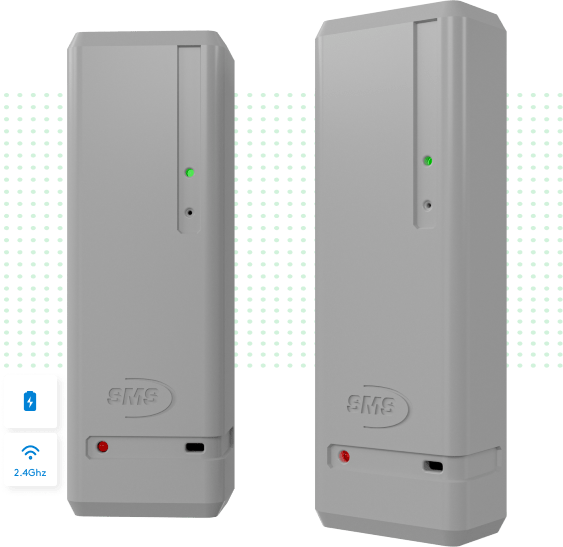
PEARL: a transmitter on one side of the door, a receiver on the other. A count is registered each time the line between them is broken; two people crossing side by side break it once.
Strengths
- Simplest to understand and to check — break the beam and you are counted, so you can verify it yourself by walking through.
- Easiest to install — a wireless beam peels and sticks at chest height: no cable, no ladder, counting in minutes.
- Cheapest to own — PEARL is $525 over five years on the free plan, the lowest five-year figure in our comparison.
- You choose who is counted by mounting height: adults only, or everyone.
- Very good on the most common entrance there is — the single or double door.
Limits
- Two abreast is one count. On a standard single or double door this rarely bites: people open one door and come through one at a time, and a double door is rarely used as two lanes at once. On a wide and very busy entrance it does, which is where another technology does better.
- Unusual movement. PEARL times each interruption and ignores a quick break, such as an arm swinging past. The filter can only go so far — push it harder and it starts ignoring people too — so it catches most stray movements, not every one. An arm swung unusually, or a hand pushing the door open at beam height on the way out, can add a count if it crosses slowly enough to get past the filter, and a person sprinting through can occasionally be filtered out. That is what PEARL’s accuracy figure means by walking normally: a normal pace and ordinary movement.
Installing it
- Height: 54 in or 24 in. At 54 in (137 cm), chest height, strollers, carts, dogs and most children pass underneath, so you count adults only; it has long been the industry’s accepted height for telling adults from children. At 24 in you count everyone, as libraries and museums usually want. Legs and bags cross the beam at that height too; PEARL times each interruption and ignores those quick breaks, which is what keeps them from adding counts. With another beam, ask whether it filters short breaks before mounting it that low.
- Door swing. Frameless glass and inward-swinging doors are the awkward ones. Not because of the glass — a stick-on beam mounts on it fine — but because these doors pivot a few inches in from the edge, so the backswing crosses the beam even opening outward, and their tall pull handles break it as well. Mount beyond the swing or use an overhead sensor.
- Automatic doors with infrared safety curtains. The door’s own strong infrared pulses interfere with a low-power counting beam; mount at the wall edge or further into the store (our notes).
- Open mall entrances. On a door frame nothing gets in the way — nobody puts a display in a doorway — but at an open entrance a rack or mannequin on the lease line can block the beam. PEARL emails you within minutes if it is blocked.
- Within reach. Units at chest height are easy to bump, block or, occasionally, sabotage by a manager under pressure about conversion. The same alert tells you when its beam is obstructed.
Variants
Reflector beams use one active unit and a mirror; cheaper, but the reflector is bulky, easily knocked and prone to sunlight errors. Transmitter/receiver (Rx/Tx) beams are smaller and more reliable, and are what PEARL uses. Directional beams put two beams a few centimeters apart on each side: A then B is an entry, B then A an exit. Wireless beams pulse the beam to save power and run for months on a set of batteries; they are the entry point for most first-time buyers, at the price of a battery routine — and because PEARL stores counts through a network outage and emails you before its batteries run low, a dropped connection or a late battery change costs you little. For a chain of a hundred locations, that maintenance load is the real argument for spending more.
Verdict: for single and double doors that open outward, a beam is the simplest and cheapest counter to run and to check. Other technologies are better for wide entrances, but a beam’s range and low cost still make it worth considering there.
PEARL: an Rx/Tx pair on AA batteries over 2.4 GHz Wi-Fi, peel-and-stick, in/out, 15 ft range (7 ft in bright sun, which still covers most single and double doors), upwards of 98% on adults walking through normally, one at a time, $499.95 with software from $0, typically 6–9 months on a set of AA batteries. It is the right sensor for a single or double door, and the wrong one for a wide and very busy entrance — which is why we also offer a 3D stereo sensor.
Technology 2
Overhead thermal counters
A low-resolution thermal camera looks straight down and sees people as warm blobs moving across a cooler floor. Firmware tracks each blob and counts it when it crosses the line. Thermal was pioneered in the UK in the 2000s by Irisys, which stopped selling hardware in 2023 and has since closed.
Strengths
- Counts in total darkness; lighting and shadows are irrelevant.
- Can count several people at once, as long as they are not walking too close together.
- No recognizable image can be formed from a thermal array of this resolution — a strong privacy position.
- Wired or battery-powered, depending on the model. Battery models need no cable and connect over Wi-Fi, or over cellular with an additional hardware box where there is no usable network.
Limits
- People who stop. Thermal sees a person as heat that stands out from the background, and someone who stops in the doorway is a known weak spot: Irisys’s configuration guide lists people stopping in the field of view, with cross traffic, among the causes of in and out counts that don’t match. Test it: stand in the doorway for 20 seconds, walk on, and check the count.
- Arms and hands. One person can show up as more than one heat shape — an arm reaching out to push the door, for example — and the lower the sensor, the more likely it is: the same guide says arms and legs “may be seen as separate thermal objects” at very low heights. In that guide, the setting that keeps two people walking close together apart is also the one that splits one person into two, so the installer is choosing between the two errors.
- No measured height, so children and carts are excluded by estimate rather than measurement.
- Lower typical accuracy. Thermal door counters typically run 85–95% (early thermal ran 80–85%), against 95–99% for depth sensors. The gap is physical: with no height to go on, the sensor judges what is a person, a child or a cart from how big and warm a shape looks. Modern software makes that estimate far better than it used to, but it remains an estimate — two people walking close together can still merge into one shape, and a sunlit floor cooled by a draft can register as someone walking in. Irisys’s own configuration guide documents carts being counted, close pairs merging and sunlit floors triggering, with the settings used to fight each. A beam’s height cut-off, by contrast, is physical: mounted at 54 inches, anything shorter passes underneath.
Installing it
- Door-frame or ceiling mounting, depending on the model.
- Changing heat in view. A fixed heat source is usually learned as background; heat that changes is not. Sun on the floor, a draft from the door cooling it, a heater cycling on and off can register as someone walking in. Irisys’s guide calls these “ghost” targets, and its fix delays recognizing real people, so some can cross the line before they are counted. Keep sunlit floor and heaters out of the sensor’s view where you can.
Variants
Thermal still comes in wired form, and is also the technology behind today’s battery overhead counters, which pair the thermal array with machine learning and connect over Wi-Fi, with cellular as an option.
Verdict: for a dark indoor entrance thermal is a good choice, and battery models can be fully wireless. Look closely at the cost: some are sold only with a paid software plan, which can make five years of ownership cost more than many 3D counters — about two and a half times the 3D Scope II LC on its full analytics plan. Anywhere with light, 3D stereo remains the technology to beat.
Technology 3
2D (mono) video counters
A single camera looks down and software decides what crossed the line. How well it does that depends almost entirely on the software, and 2D has changed more in the last few years than any other technology here.
Strengths
- Recognizes a person by appearance, with a neural network running on the device or on a network video recorder (NVR), rather than reacting to anything that moves.
- Accuracy in the same band as depth sensors — vendors building on monocular AI now publish figures there.
- The fastest-improving technology on this page.
Limits
- Overlap from above. Two people overlapping in the image are separated by inference; a depth sensor separates them by measurement.
- Hard shadows. Much better than they were: a neural network that recognizes people by shape does not count a shadow the way older units did, and wide-dynamic-range (WDR) sensors handle glare and backlit doors. Low sun throwing long shadows across a polished floor is still the hard case. A depth sensor, stereo or ToF, ignores shadows by measurement, since a shadow has no height.
- Requires a cable. A 2D counter needs power at the door, over Ethernet or from an outlet, and ceilings above doors have no sockets: a plug-in install still ends in a cable run or an electrician. A cost either way, and one that is almost never in the quoted install time.
Installing it
- Looking straight down. Separating people needs a top-down view; a camera mounted at an angle to see faces, the way a security camera is, is the wrong geometry.
- A model suited to the entrance. The camera has to match that entrance’s light and ceiling height, and be mounted and aimed — the same work any purpose-built counter needs.
Variants
Background-subtraction units, the older kind, separate moving foreground from a learned background, which is where 2D’s reputation for shadows and shopping carts comes from: a shadow moving across the floor, a cart, a child and an adult were all just moving pixels. On-device AI units recognize a person by appearance, and the difference is large; what “AI” actually means on a 2026 datasheet is below. Re-used security cameras are a third option, and a different proposition:
A security camera is mounted at an angle to see faces, which is the wrong geometry for separating people who overlap. It is also doing another job: the counting depends on a device chosen for surveillance, a separate NVR or DVR doing the processing, and a data path from camera to recorder to platform — every stage another thing that can fail or fall behind, where a dedicated counter does the work where it stands.
The reasonable answer to that is “so add a camera, pointed straight down”. It is a fair point, and it is also the moment the comparison changes. You are now buying hardware, choosing a model suited to that entrance’s light and ceiling height, and paying someone to mount and aim it — the same work a purpose-built counter needs — while still keeping the recorder, the integration and every link in that chain. Once you are installing something either way, a dedicated counter is competing on equal terms, and the analytics license for the camera route usually costs more than the sensor would have.
Verdict: a modern 2D counter with on-device AI, mounted straight down, is a serious option and closing the gap on depth sensors quickly; depth still has the edge on close crowds and hard shadows, because it measures rather than infers. A re-used security camera is a different purchase, to be judged on the whole chain rather than the camera.
Technology 4
3D stereo vision counters
A stereo counter sees depth the way your eyes do. Each eye sees the scene from a slightly different angle, and your brain turns the difference into distance; the sensor does the same with two lenses a few centimeters apart, and works out how tall everything below it is. That is what a single camera lacks. An adult is a head at adult height, a child is shorter, a cart is low and flat — and on-device AI adds shape recognition on top of the measurement, so a cart or a wheelchair is told apart from a person. Each person is tracked across the view and counted once, in the direction they crossed the line. “3D” and “stereo” mean the same thing in this industry, and since about 2010 stereo has been the technology to beat for retail; nearly every enterprise vendor, ourselves included, builds on it.
Strengths
- People walking abreast are separate heads, so groups are counted correctly.
- Height filtering excludes children, carts and strollers by measurement rather than by mounting height; shape recognition can count carts and wheelchairs separately.
- U-turn filtering and “count once per crossing” logic ignore greeters, lingerers and the customer who steps in to check the weather.
- Multiple count lines per sensor, and several sensors stitched to cover a wide lease line as one.
- Staff exclusion with wearable ultra-wideband tags, which the sensor ignores without identifying anyone.
- Immune to shadows, which have no height, and with HDR imaging to glare and backlighting.
- Auditable: the sensor can record a short clip with count lines overlaid so you can verify it yourself.
Limits
- Darkness. Stereo needs some light to match what its two lenses see. The 3D Scope II LC works down to about 3 lux, and we recommend at least 6; other vendors’ figures vary. Thermal wins here.
- Requires a cable. A stereo counter needs power at the door, over Ethernet or from an outlet, and ceilings above doors have no sockets: a plug-in install still ends in a cable run or an electrician. A cost either way, and one that is almost never in the quoted install time.
Installing it
- Reflective floors and glass in the field of view, hanging signs, plants and pendant lights. Keep them out of the sensor’s view.
- Placement over the door swing, stairs, escalators or a revolving-door mechanism; mount on the flat floor 1–2 ft inside.
Variants
Standard units cover ceilings up to about 6 m (3D Scope II LC coverage chart); high-mount models rated to 20–25 m cover atriums and concourses.
Verdict: the most complete counter for a bright, busy retail entrance — groups, children, carts and U-turns handled by measurement — at the price of a cable run and enough light.
3D Scope II LC: stereo with on-device AI and HDR, 99% rated with a 95% floor guaranteed in writing for two years, one PoE cable under 8 W, coverage up to 6 × 5 m (19.7 × 16.4 ft) per sensor, wider with two or more, in/out, adults and children, carts, groups, wheelchairs, U-turns, staff exclusion, video audit on request; $1,149.95. Where we lose: ceilings above 9 m, and age and gender, which the 3D Scope II LC does not estimate.
Technology 5
Time-of-flight (ToF) and LiDAR depth counters
A time-of-flight sensor emits pulses of infrared light and times their return from every point below; the round-trip time gives distance, and distance from the ceiling gives height. The result is a depth map very like a stereo sensor’s — heads, carts and children distinguished by height, groups separated, direction known — but produced without any color image at all. Popularized by the Microsoft Kinect, ToF was “new and promising” when we last wrote about it in 2016. It has since matured into a real alternative to stereo from several specialist vendors.
Strengths
- Privacy by physics. The sensor measures distance, not light: the picture it forms is a depth silhouette with no face, color or clothing in it, so there is nothing to blur or redact. This is the cleanest answer to a procurement rule that says “no cameras”.
- Works in darkness, since it brings its own light.
- Stereo-class group separation and height filtering.
Limits
- Sunlight, and not equally. A time-of-flight sensor times how long its own pulse of light takes to bounce back, so it has to pick a faint return out of everything else lighting the scene — and daylight is overwhelming by comparison. How well a unit copes depends on the component inside, and the spread is wide: sensor manufacturers sell ambient-light rejection as a headline feature, and the trade is reach — one widely used ranging part quotes 4 m in its long-range mode but about 1.3 m in the mode built to resist bright surroundings. We have tested this ourselves and found low-cost ToF counters badly inaccurate at entrances with real daylight where a better-specified unit coped.
- Crowded, slow-moving entrances are its hardest case, as vendors acknowledge.
- Verification is weaker than video. Most units let you watch the depth view live while you aim them, which is enough to confirm the sensor is working. It is not enough to settle a disputed count the way a recorded clip with the count lines drawn on it does — a silhouette tells you something person-shaped crossed, not that it was a person.
- Requires a cable. A time-of-flight counter needs power at the door, over Ethernet or from an outlet, and ceilings above doors have no sockets: a plug-in install still ends in a cable run or an electrician. A cost either way, and one that is almost never in the quoted install time.
Installing it
- Indoor entrances. ToF remains an indoor technology; treat “works in any lighting” as a claim to test at your own door, in the afternoon.
- Range and resolution fall with height, so coverage per unit is smaller than stereo and wide entrances need more sensors.
Variants
LiDAR units apply the same principle with scanning lasers over larger areas.
Verdict: the choice when a rule says “no cameras” and you still want depth-class counting. Test it in daylight at your own entrance, and expect to need more units than stereo on a wide one.
What changed since 2016
AI and edge processing: what “AI people counter” actually means
AI in people counting comes in two kinds, and not every AI counter processes on the device. Cloud AI sends images or live video to a server or the cloud for processing. Edge AI processes on the sensor itself, so only metadata leaves it — ins and outs, adult and child counts, dwell time and heat-map data. Every SMS Storetraffic sensor that uses AI is edge AI: no images or video are sent to a server or the cloud for processing. The difference between the two deserves its own article.
“Edge AI” on a 2026 datasheet means the sensor runs a neural network on the device to classify what it sees, rather than applying hand-written rules. On a stereo or ToF sensor the network works on depth data: it learns what a head, a cart, a wheelchair, a stroller and a child look like from above, so the sensor can count carts separately, count a wheelchair user as a person, tell a tall child from a short adult better than a fixed height threshold can, and separate a tight group. On thermal sensors, machine learning has closed much of the accuracy gap to cameras. On 2D video, AI object detection rescued a technology that background subtraction had left behind.
Three things it does not mean. It does not mean video is being sent to the cloud — the whole point of edge processing is that only metadata leaves the device. It does not mean face recognition; a counter trained on head shapes from above never sees a face. And it does not mean accuracy is solved: an AI sensor mounted over a door swing, in the dark, or above its rated height still counts badly. The useful questions are the same as ever — what does the sensor capture, what leaves it, and what is the guaranteed floor.
Where AI adds capabilities that need more care: age and gender estimation, and re-identification — recognizing the same person again, across sensors or on a later visit. How each is built decides its legal footing. Age and gender estimated on the sensor, with only statistics leaving it and no one identified, is not treated by EU regulators as biometric identification; Canada’s privacy commissioners found that face-based age and gender estimation in shopping malls required express consent, and Illinois’ biometric law covers any scan of face geometry. Re-identification goes further, because its purpose is to single one person out: some systems do it with face recognition, and some send images of faces to a server to do it. For either feature, ask what it works from, where the processing happens and what leaves the sensor before you switch it on. Retailers that got this wrong made the news for tracking their customers. In the US, a pharmacy chain was banned from facial recognition for five years, and cameras on pharmacy and grocery shelves that could guess shoppers’ age and gender made national news. In Canada, a mall operator collected five million shoppers’ images to estimate their age and gender, and a dozen hardware stores were found to have broken privacy law with facial recognition. The damage to their reputation was far larger than anything the data was worth.
Technology 6
Wi-Fi, Bluetooth and cellular counting: they count devices, not people
Sensors that listen for wireless signals — Wi-Fi, Bluetooth or cellular — count devices, not people, and not only phones. That is the whole limitation, and no amount of signal processing removes it.
“Phone counting” covers three different technologies, and they measure different things:
| Method | What it actually measures | What it cannot tell you |
|---|---|---|
| Wi-Fi and Bluetooth sensing | How many broadcasting phones are nearby, estimated despite address disguising — the best research reports about 92% of broadcasting phones in range | How many people, who crossed your door, or anything about phones that are asleep or not broadcasting |
| Cellular signal sensing | How much mobile-phone radio energy is in the air, used to estimate phones nearby | Individual phones, direction, or where your store ends and the sidewalk begins |
| Carrier or app location data | Free sources: how busy a place is compared with its own usual peak. Paid providers: an estimated visit count, extrapolated from a panel of phones | Your actual door count — the figures are modeled rather than measured, and each provider defines a “visit” differently |
A device is not a person, and phones are not the only devices that broadcast. Wi-Fi and Bluetooth sensing also pick up smartwatches, fitness trackers, wireless earbuds, tablets, laptops, e-readers, handheld game consoles, Bluetooth item trackers, portable hotspots and the car waiting at the curb; cellular sensing picks up anything with a mobile radio, from cellular watches and tablets to connected cars and card terminals on a mobile connection. One shopper with a phone, a watch and earbuds can count as several devices; a child with none counts zero. A device that is asleep, has Wi-Fi off or is not transmitting is not counted at all, while fixed devices in and around the store transmit all day and have to be filtered out. And these signals pass through walls, so the sensors cannot cleanly separate shoppers inside your store from people walking past it.
Wi-Fi and Bluetooth counting became much harder when Apple and Google began disguising phones’ hardware addresses from 2014–2015. Researchers can still estimate how many broadcasting phones are nearby — the best recent method reports about 92% accuracy — but that is 92% of broadcasting phones in range of a receiver, not 92% of people, and not people crossing a door. To turn phones into people, the researchers had to calibrate against a separate people count.
Cellular counting measures how much mobile-phone radio energy is in the air and estimates from it how many phones are nearby. It identifies no one, which is to its credit, but it reflects what phones are doing rather than how many people are present. Reading a phone’s actual identity from its signal is off limits to any commercial counter: in the United States under the federal Pen Register Act and section 605 of the Communications Act, in Canada under section 9 of the Radiocommunication Act.
All of these methods also depend on how phones behave today, which phone makers and standards bodies keep changing to protect privacy. A method that works this year can stop working after a software update.
Phone-signal data is useful for dwell time, zone flow and trade-area context in a large venue. It is not a door count.
The radio technology that is useful at a door in 2026 is ultra-wideband, in the other direction: staff carry a UWB tag and a receiver on the sensor tells the counter to ignore them (how our staff exclusion works). Consent is built in, because the only devices tracked are the ones you handed out, and the tags identify no individual.
Also seen
Pressure mats, turnstiles, door counters, radar and location data
Turnstiles and gates
Effectively 100% accurate per turn, because they enforce single file. Right for stadiums, transit and paid entry; wrong for a shop, where a barrier is a customer deterrent.
Pressure mats and smart flooring
Count footsteps or weight on a threshold mat. Cannot separate people, wear out, and are confused by carts. Niche.
Door-swing and magnetic counters
Count door openings, not people. Someone holding the door for another customer is one count, a propped-open door is none. Acceptable only as a rough activity indicator.
mmWave radar
An emerging privacy-friendly option for presence and occupancy in rooms; works in darkness and through some materials, but struggles to separate people close together. Watch this space for corridors; not yet a retail door counter.
Mobile-location datasets
Location-data panels estimate visits to a category or a trade area from aggregated phone location data. Invaluable for market context, but an estimate — not a measurement of the traffic coming into your store.
Tally counters with a display
A beam counter with a number on the front and no software. More accurate than a person, but you are the software: reading, resetting, typing into a spreadsheet. Most owners stop within months.
Direction
IN and OUT: what each count tells you
Every serious people counter now counts in both directions. Overhead sensors track each person across their view and know which way they crossed the line; directional beams such as PEARL use two beams a few centimeters apart, so A then B is an entry and B then A an exit. IN is the number almost everything is built on: traffic, conversion rate and staffing all use the count of people coming in, because the moment someone walks in is the moment they may need help to become a customer.
It was not always this way. Many early counters, single beams above all, could not tell direction, so the industry took the total count and divided it by two: over a day the people who come in are the people who go out, so half the total lands close to the IN count. With directional counting standard, there is no need to estimate a figure the sensor simply reports.
OUT earns its place when you need to know what happens after the door: occupancy, time spent in the store, and how customers flow between entrances. Occupancy is the one to handle with care. It is cumulative IN minus cumulative OUT, so every counting error persists. A 95%-accurate sensor at a door seeing 100 people an hour makes about five errors an hour; if they lean one way, and they do, the system believes there are 25 phantom people in the store by closing and 60 by Sunday night. That is arithmetic, not a fault, and it matters for staffing: an accumulated error makes the store look fuller than it is, which can lead you to staff more than necessary. Live occupancy is a legitimate use — for capacity limits, gyms, study halls, event floors — but it needs a high-accuracy sensor on every entrance, a daily reset, and a manual correction button, which is how our Real-Time plan is built.
The “group counting” feature
Some sensors offer to count people who enter within a set distance of each other as one “shopping unit”, which raises the reported conversion rate. The distance rule cannot know whether two people are a couple, colleagues or strangers who arrived together, so it is arbitrary at best and flattering by design. We have offered it and we advise against it: count people, know that some of them shop in groups, and measure your improvement against a consistent baseline.
Several entrances
How do you count a store with two entrances without double counting?
Put a directional counter on every entrance customers use, and count the store’s traffic as the sum of IN at all of them. In SMS Storetraffic installations, each entrance has its own counter and the location reports one total, so a shopper who walks in the front and out the side is one IN and one OUT: one visit, not two.
- Count every entrance customers use. An uncounted side door leaves its visitors out of traffic, which makes the store’s conversion rate look higher than it is.
- Report traffic as the sum of IN across all entrances. Never add IN and OUT together: that counts each visitor twice.
- If a counter cannot tell direction, halve the store’s combined total, not each door’s. Over a day the people who enter a store are the people who leave it, but not always by the same door.
- Treat one wide entrance as one door. Two overhead sensors watching the same crossing count it twice unless their views overlap and the software merges them; on the 3D Scope II LC the overlap is at least 1 m (3.3 ft).
- Check the store as a whole, not door by door. Total IN and total OUT should nearly match over the last 14 days; at a single door they will not, because customers leave by whichever door is closest. The accuracy guide sets out the formula and thresholds.
Decision
Which technology for which entrance
| Entrance | Choose | Avoid | Why |
|---|---|---|---|
| Standard single or double door, outward-opening or none, mostly single file | Wireless infrared beam | Paying for stereo | Consistent and cheap; the side-by-side undercount is small and stable at this traffic level |
| Busy door with groups, families, carts and strollers | 3D stereo, or ToF indoors | Beam | Only depth separates people abreast and filters by height |
| Wide lease line or open shopfront, 4–8 m | Stitched 3D stereo; a beam on a limited budget | Single thermal (too narrow) | Multiple sensors work as one; coverage grows with height. A beam costs far less where the opening is within its range, but counts people walking side by side as one |
| Frameless glass, automatic sliding, or inward-opening doors | 3D stereo | Beam, thermal | No mounting point, door swing breaks the beam, safety curtains interfere; a moving door changes the heat a thermal sensor sees |
| Dark entrance, cinema, nightclub, storage | Thermal or ToF; a beam on single and double doors | Stereo, 2D video | Cameras need light; thermal, ToF and beams do not |
| No network, no cable, no IT | Battery beam on Wi-Fi, or battery thermal on cellular | Anything PoE | The only two wire-free categories |
| Ceiling above 6 m | Our 3D Scope II HC up to 9 m (on request); above that, high-mount stereo from a specialist vendor | Standard stereo, thermal, ToF | Range |
| “No cameras” procurement rule | ToF, thermal or beam | Stereo and video, however configured | These three cannot form an image; the rule is satisfied by physics rather than by settings |
| Staff constantly crossing the line | Stereo with UWB staff exclusion | Beam, thermal (no way to exclude) | Tags let the sensor ignore employees without identifying them |
Common questions
People-counting technology: questions people ask
What is the most accurate people counting technology?
Thermal vs camera people counters: which is better?
How does an infrared beam people counter work?
What is the difference between 3D and stereo people counters?
Can a Wi-Fi people counter still count people in 2026?
Can a people counter count cell phone signals?
Do people counting cameras store video?
How high should a people counter be mounted?
How wide an entrance can one people counter cover?
Can a people counter tell adults from children?
Do I need a cable to install a people counter?
What is an AI people counter?
Which people counting technology is best for privacy?
Is directional IN/OUT data useful?
Since 1972
One beam, one 3D camera
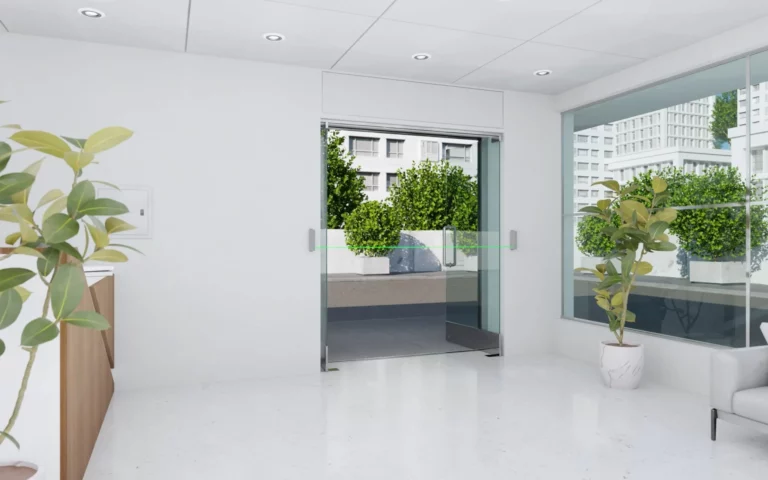
PEARL — wireless infrared beam SMS Storetraffic
Rx/Tx pair on AA batteries over 2.4 GHz Wi-Fi. Peel-and-stick, in/out, 54 in or 24 in mounting, doors to 15 ft. Upwards of 98% on adults walking through normally, one at a time. For single and double doors; not for wide and very busy entrances.
USD $499.95 · software from $0
3D Scope II LC — stereo with edge AI SMS Storetraffic
Groups, height and shape filtering, carts, wheelchairs, U-turns, staff exclusion, multiple lines, video audit on request. 99% rated, 95% floor guaranteed for two years. PoE, up to 6 × 5 m coverage at a 4 m ceiling, mounts up to 6 m in extended mode (smaller area); HC model on request for ceilings up to 9 m.
USD $1,149.95
Check our work
Sources
Our own specifications come from our product pages and help center, linked in place. Industry accuracy ranges are the figures vendors publish for their own products, summarized without naming them; no competitor is quoted or linked on this page. Named comparisons live on the comparison page.
Specifications and mounting heights
- SMS Storetraffic — 3D Scope II LC installation; coverage chart; PEARL and automatic doors; UWB staff filtering
- Wikipedia — People counter (history and generational accuracy figures)
- Irisys — Gazelle PCST User Guide (IPU-40521) (how a thermal counter separates couples and groups, and the sunlit-floor false target)
Time-of-flight and ambient light
- STMicroelectronics — VL53L1 time-of-flight ranging sensor datasheet: long-distance mode reaches 4 m, while the mode built for ambient-light immunity is limited to about 1.3 m
- ams OSRAM — time-of-flight sensor technology (“best-in-class high ambient light immunity — 20x higher peak power compared to 3D ToF solutions currently available in the market”)
Phone-signal counting
- Apple — Use private Wi-Fi addresses (iOS 14 per-network address; iOS 18 rotation every two weeks)
- MAC address de-randomization for WiFi device counting (Computer Networks, 2022) — shows device counts can be recovered despite randomization
- He, Chang, Lin and Chan — RateCount: learning-free device counting by Wi-Fi probe listening (arXiv preprint) — about 92% of broadcasting devices within an access point’s range; converting to people required a separate device-to-person calibration
- IETF RFC 9724 — State of affairs for randomized and changing MAC addresses (March 2025) — randomization policies differ by vendor and “can evolve with time”; describes the IEEE 802.11bh and 802.11bi privacy work
- Google — About popular times (busyness shown relative to the place’s typical weekly peak, from opted-in Location History)
Cellular signals and the law
- 18 U.S.C. § 3121 and § 3127 — the Pen Register Act and its definition of recording or decoding signaling information
- 47 U.S.C. § 605 — unauthorized interception of radio communications, including their existence
- Radiocommunication Act, section 9 (Justice Canada)
Rules on video surveillance equipment
- U.S. Election Assistance Commission — What is Section 889 of the FY 2019 NDAA?
- FCC — List of equipment and services covered by Section 2 of the Secure Networks Act
- FCC — fact sheet, October 2025 order on previously authorized equipment and covered components
- Innovation, Science and Economic Development Canada — Investment Canada Act national security decisions
Face analytics in retail: regulator findings
- Office of the Privacy Commissioner of Canada — Cadillac Fairview collected 5 million shoppers’ images (2020)
- Federal Trade Commission — Rite Aid banned from using AI facial recognition (2023)
- CBC — Canadian Tire stores in B.C. broke privacy laws on facial ID technology (2023)
- NBC News — cameras that guess your age and gender come to store shelves (2019)
Prices
- SMS Storetraffic — nine systems compared (all published vendor prices, verified quarterly)
How this guide was made
This page replaces the three-part “How customer counter technology works” series we published in 2016, keeping what has stayed true — the 54-inch rule, the beam’s failure list, the thermal standing-still problem, the occupancy drift arithmetic, the skepticism about group counting and Wi-Fi — and updating what changed: time-of-flight matured, edge AI arrived, Wi-Fi counting became an estimate of devices once phones began disguising their addresses, and prices fell. SMS Storetraffic sells two of the technologies described; we say so where they appear and name other vendors where they fit better. Corrections via our contact page.