


Expert guide · People counting
People counters explained: the 2026 guide to foot traffic counting
What a people counter is, how the sensors actually work, what an accuracy figure does and does not promise, what a system costs in 2026, and where the privacy line sits under GDPR, the EU AI Act and North American law. Written to answer the questions people actually ask — with the sources linked. It covers counting at building entrances and inside buildings; outdoor counting is a different job and is not covered here.
Published by SMS Storetraffic. We have sold people counters since 1972, so we have a stake in you buying one. Where a claim is ours, it is labeled; where it is someone else’s, it is linked. Read accordingly.
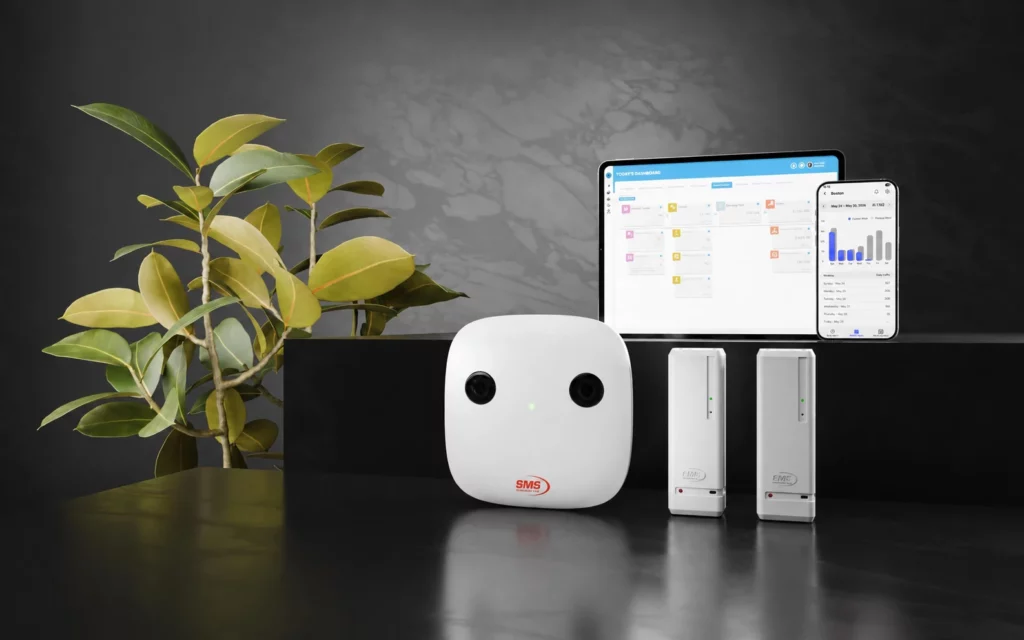
A beam sensor, a 3D camera and the software that turns their counts into decisions — our platform
The short answer: a people counter is a sensor mounted at an entrance that records how many people pass, usually in each direction, and sends the totals to software. In 2026 the sensors are infrared beams, thermal arrays, 3D stereo cameras and time-of-flight depth sensors. Good 3D and time-of-flight sensors count 95–99% of people; infrared beams count 95–98% of adults walking single file. They cost $300–$2,000 per door plus $0–$150 a month for software and, when they are designed to count rather than to watch, process no personal data at all.
What it is forUnderstanding what is really going on by removing perception and feelings and empowering you with actionable data. A good example, for retail, you can understand what really drives sales when you know your traffic, as Traffic × conversion rate × average sale = sales. Without the traffic number, a slow week and a badly staffed week look identical at the register.
Comparing storesCompare conversion rate, not raw counts, with a counter on every public entrance and the same counting rules in every store.
What accuracy meansA ceiling (“up to 99%”) and a floor (“never below 95%”) are opposite promises. Ask for the floor, and for how it is verified. Consistency matters more than the last percentage point. Traffic flows and buys in predictable patterns, and a consistent sensor will allow you to trust the pattern.
What it costsWireless beam sensors from about $300–$500; 3D sensors from about $300, most $650–$1,200, outdoor and specialized units to $2,000; software from $0 to about $150 per location per month. The cable run to the door, when one is needed, is the cost nobody quotes.
Is it legalYes. A counter that stores no images and identifies nobody processes no personal data under GDPR, is untouched by the EU AI Act’s prohibitions, and collects no biometric identifier under Illinois BIPA or Quebec’s Law 25. Camera systems that keep video, estimate age and gender or re-identify people are a different matter, and worth more questions.
Manual countingUndercounts by 8–25% in the one peer-reviewed comparison we know of, and costs more in wages within a week than most sensors cost outright. Humans are the worst people counters… you can quote us on that.
Definition
What is a people counter?
Definition
A people counter is an electronic sensor installed at a doorway or passage that detects each person crossing an invisible line and records the crossing, usually with its direction. The sensor is the hardware half of a people counting system; the software half stores the counts by time of day, combines them with sales, staffing and weather, and reports them.
The same device goes by many names depending on country and industry: footfall counter (United Kingdom, Europe), foot traffic counter or store traffic counter (North America), door counter, visitor counter, customer counter, patron counter (libraries), attendance counter (worship, events), among others. The metric they all produce is traffic: the number of people who entered a defined space in a defined period.
Two things a people counter is not. It is not a security camera: it does not record who came in, and a purpose-built counter stores no images at all (more on that under privacy). And it is not a mobile-location dataset: services that estimate visits from smartphone location data describe a market; a counter measures your door. A security camera system with its NVR/DVR may also be able to count, but is typically not specialized in this, and a camera that aims to count is typically not placed correctly to also provide a clear view for security, leading to more cameras and less accuracy on both systems.
People counters started in retail — the first United Kingdom beam counters were installed at Meadowhall in 1988, covering 14 entrances (Wikipedia) — and retail is still the largest user, providing an easy and time-proven ROI. But the same sensors now count library patrons for annual reporting, museum visitors for grant applications, congregations, gym members, office occupancy and passengers.
Mechanism
How do people counters work?
Every automated people counter does the same three things: it detects a person crossing a count line, it decides whether that crossing is a valid count (and in which direction), and it records the count with a timestamp for software to aggregate. What differs between technologies is how the detection is done — and therefore what confuses it.
Detect
A horizontal infrared beam is broken in a certain sequence; a thermal array sees a warm shape move across a cold floor; a stereo camera computes the height of everything below it and sees a head-shaped object at 1.6 m; a time-of-flight sensor measures the distance to the floor change. Each is a different way of answering “is a person here?”
Decide
The sensor’s firmware turns detections into counts. This is where the intelligence lives: was that one person or two side by side? A child, a cart, a stroller? Someone who walked in and straight back out? A person standing in the doorway for a minute? Did these multiple people seem to act like a group? Infrared sensors apply a time-proven rule (anything that breaks the beam is one count); 3D and AI sensors track and analyze each object across the field of view and count it once, when it crosses the line, in the direction it went.
Record and report
Counts are timestamped, buffered on the device and sent to software — by Wi-Fi, Ethernet or cellular — at intervals from real time to hourly. The software does the useful work: hourly and daily totals, business-hours filtering, comparison to sales and staff hours, alerts when a sensor goes quiet.
The five sensing technologies in use in 2026 are summarized below. Each has a full section, with what breaks it and where it belongs, in the technology comparison.
| Technology | How it detects | Counts groups side by side | Filters children / carts | Typical accuracy claim | Power | Privacy |
|---|---|---|---|---|---|---|
| Dual Horizontal infrared beam | A transmitter and receiver across the doorway; break the beams and you’re counted and direction is determined. | No — two abreast is one count | Yes, by mounting height | 95–98% on single-file adult traffic | Batteries or wired | Ultimate privacy. Sees nothing; no image exists |
| Overhead thermal | A low-resolution heat map; warm shapes tracked across a cold floor | Yes, until shapes overlap | Inferred, not measured | Typically 85–95% | Wired or battery | No recognizable image |
| 3D stereo vision | Two lenses compute a height map; heads are tracked as objects | Yes | Yes — by height and shape | 95–99% | PoE (one cable) | Depth data; video off by default on good systems |
| Time-of-flight / LiDAR | Infrared pulses timed to the floor; a depth map with no color image | Yes | Yes — by height | 95–99% | PoE (one cable) | Depth silhouette; no face, color or clothing |
| Cellular / Wi-Fi / Bluetooth sniffing | Counts phones, watches and other devices broadcasting nearby | Counts devices, not people | No | Estimates | Wired | Device identifiers — regulated and subject to changes with evolving telecom standards. |
Accuracy figures are a generalization of most vendors’ published claims for their own products under good conditions; see what accuracy means. Features may vary by vendors and by products.
Purpose
Why count people at all?
Because, if you serve people who do not carry a ticket or an access tag, you are optimizing against a number you have never measured. For retailers, sales figures tell you what happened, and only traffic tells you why. A store that sold less this week either had fewer people walk in, or converted fewer of the people who did, or sold them less each. Those are three different problems with three different fixes — marketing, staffing and service, merchandising — and a sales receipt cannot tell them apart. This is the Retail Equation:
Traffic × Conversion rate × Average sale = Total sales
Two of the three terms come from the point of sale. The third only exists if something counts the people who did not buy. That is the whole case for a people counter: it is the only instrument that measures the opportunities you did not convert. If you run a store, see how a retail store traffic counter works.
The stakes have not moved online. E-commerce was 17.1% of U.S. retail sales in the second quarter of 2026 (U.S. Census Bureau), so roughly five dollars in six are still spent in a physical store. And the store visit itself is changing: ICSC and McKinsey’s April 2026 report, based on a survey of 3,004 U.S. consumers, finds shopping trips becoming less frequent and more intentional as people research before they leave home (Shopping in the Age of AI). Fewer, more deliberate visits make each one worth more — and make knowing how many you had, and how many you converted, matter more rather than less.
Your first conversion rate is a starting point, not a verdict. Almost everyone is disappointed by it. Most mall-based specialty stores sell to fewer than half the people who walk in; many sell to fewer than one in ten (our own experience since 1972). The number does not matter; the trend does. A store that moves from 10% to 11% conversion has grown sales 10% with the same rent, the same traffic and the same marketing spend. The good news: the lower your rate starts, the more room you have to improve.
12–20%
where most stores land the first time they count
Operators who believed they converted 80% of visitors discover it is 12–20% once a counter is installed (our archive). Four more sales per hundred visitors on a 20% base is a 20% sales increase.
2% → 7%
closing ratio over three years
An international apparel chain that installed counters to set staff-to-traffic ratios, then added hours at peak periods while competitors cut them. Sales rose and wage cost fell as a share of sales (our archive).
$1.45B
people-counting market, 2025
Growing about 13% a year to roughly $3B by 2031 (Mordor Intelligence; Fortune Business Insights puts 2025 at $1.46B). Retail is the largest segment; occupancy analytics the fastest-growing driver.
What is a good retail conversion rate?
There is no single answer, and be suspicious of anyone who gives one without a vertical. In our experience, store operators who start counting usually discover a conversion rate somewhere between 12% and 20% — far below the 50% or more most of them believed (our archive). Most mall-based specialty stores sell to fewer than half their visitors and many to fewer than one in ten. Grocery converts most visits because people arrive intending to buy, so a traffic count has less value there; luxury converts least because people arrive intending to look. The independent ranges below are the ones Shopify publishes in its 2026 retail guide; no sample sizes are given, so treat them as directional.
| Store type | Typical conversion | Why |
|---|---|---|
| Specialty retail | 15–30% | A mix of intent and browsing; the range where most of our customers start |
| Big-box formats | 10–20% | Large footprints, comparison shopping, many visits that end without a basket |
| First-time counters, all formats (our experience) | 12–20% | What operators usually find in the first month, against a belief of 50% or more |
Format ranges from Shopify, Retail Conversion Rate (updated March 2026); the first-time-counter range is our own observation, first published in 2016. For comparison, Shopify puts online conversion at roughly 1.6–3%.
Beyond retail: where a visitor count is the product
For a growing number of institutions the count itself is the deliverable. Public libraries in the United States report “library visits” every year through the IMLS Public Libraries Survey, which defines a visit as the total number of persons entering the library for whatever purpose — and IMLS has acknowledged that reported counts can be inaccurate because of limited counting technology and unrepresentative “typical week” sampling multiplied by 52 (our guide to the IMLS requirements). Museums use attendance to support grant applications. Places of worship track attendance trends; offices measure desk and meeting-room utilization; gyms, transit and event venues manage live occupancy against a capacity limit. The sensors are the same; the software emphasis shifts from conversion to reporting and occupancy.
Decisions
What do you actually do with foot traffic data?
Work out your minutes per visitor
Staff on the floor, times the hours they are there, times 60, divided by the visitors who came in. Two people over a ten-hour day is 1,200 staff-minutes; 200 visitors makes six minutes of attention per visitor — per visitor, not per sale. Then ask the only question that matters: is six minutes enough to sell what you sell? A jeweler who needs twenty has an answer. So does a convenience store that needs one.
Run it again on your busiest hour rather than the whole day, because that is where it breaks: a store averaging six minutes can be down to two at four o’clock. And when the number is too low, more hands is only one of the answers — radios, a fitting-room host or a second register buy back the same minutes.
Measure marketing by the door
A campaign either brought more people to your location or it did not. Comparing traffic in campaign weeks against the same weeks last year, or a known comparative period, by hour, is the only clean measure of local marketing, window displays, events and opening-hours changes — sales confound it with conversion and price.
Find the key selling periods
Traffic by the hour shows every store has hours that convert well above its average and hours well below. Some of that is who walks in: your buying-traffic hours convert higher whatever you do. The part you control is matching service level to the traffic, and it costs you most in exactly those hours, where the customers you lose were the likeliest to buy.
Capture rate and layout
A second sensor facing the mall corridor or the street gives passers-by; entries divided by passers-by is your capture rate — the window display’s conversion rate. Inside, counters on department thresholds show which areas are visited and which are walked past.
Prove impact
For libraries, museums, community centers and places of worship, a continuous, timestamped count is the difference between “we estimate 40,000 visits” and a defensible annual figure for boards, funders and the Public Libraries Survey.
Several locations
How do you compare foot traffic and conversion across store locations?
Compare ratios, not raw counts: conversion rate (transactions ÷ traffic), reading each store against its own same weeks last year before ranking it against the others. That only works if every store counts every public entrance by the same rules and records transactions the same way.
| Rule | Why it matters | Common mistake |
|---|---|---|
| Count every public entrance | A count with a door missing is a ratio with a hole in it | An uncounted side door makes a store look quiet and its conversion rate look high |
| Use the same counting rules at every door | Height filter, U-turn logic and staff treatment are part of the number | One store counts children or staff and the next one does not |
| Use one definition of traffic | Traffic is IN counts, or total beam counts divided by two, in every store | Mixing IN-only counts with IN + OUT totals doubles some stores |
| Compare conversion rate, and traffic over the same opening hours, not raw traffic | Raw traffic depends on the location | Ranking a mall unit’s raw traffic against a street store’s |
| Compare each store with itself first | The same weeks last year, by hour, take out local seasonality | Ranking stores on one week or one event day |
| Start a new baseline when a store changes counters | A new counter can read more or less traffic from day one while sales stay the same | Comparing a store across its switch date, or against stores still on the old counters |
| Use one definition of a transaction | Returns, exchanges and online-order pickups must count the same way in every store | One store’s POS counts pickups as sales and the next does not |
Check a store’s counter before you rank it: SMS Storetraffic flags a location for investigation when its IN and OUT totals diverge by roughly 5% over the last 14 days. For more than a few stores, use counting software that totals each store’s sensors as one location and keeps transactions beside traffic, then export to Excel or the BI tool head office already uses.
The honest section
How accurate are people counters?
Modern 3D and time-of-flight counters, installed properly, count between 95% and 99% of the people who cross the line; beam counters count 95–98% of single-file adults and less when people walk abreast. Those numbers are real, but they are not what most buyers think they are. They are the vendor’s count measured against the vendor’s own definition of what should have been counted, arrived at by having a team audit sample footage. Nobody reviews every video. Doing that would mean streaming every door to a server and paying people to watch it, which is the exact job the sensor exists to do.
1. A ceiling is not a floor. “Up to 99%” is the best result a vendor has seen over some period. “Never below 95%, verified by video, or we fix it” is the worst day you are willing to accept. Only a minority of vendors in our nine-system comparison commit to a floor at all; SMS Storetraffic backs its 3D Scope II LC with a 95% floor for two years. Ask for the minimum a vendor will stand behind, and how it is verified.
2. The rules are part of the number. Most counters are tuned to count adults, which in practice means anything above a height threshold with a roughly human shape. That is already a proxy, and in retail it is a proxy for something else again: the point was never to exclude children, it was to exclude people who cannot buy. It holds until a ten-year-old is as tall as an adult. Group counting has the same shape of problem — the sensor assumes that people arriving together, spaced similarly and moving on the same path, are one party, and that breaks down quickly. This is why we publish an accuracy figure for adults and decline to publish one for children or groups: a child sits between “object to ignore” and “adult to count precisely”, and two people watching the same doorway would not agree on where a group starts. Ask any vendor what their rules are — children, staff, the customer who steps in and straight back out, the person who stands in the doorway for two minutes — and agree them before you audit anything.
3. Consistency is accuracy that holds. An accuracy rating is measured under particular conditions; you still have to factor in consistency. A sensor rated at 98% that is thrown off whenever sun floods the entrance reads 98% most of the time and far less for those hours, and once one period is measured differently from another, the comparison — the reason you count — is gone. The same goes for time not counted at all: an outage on a sensor that does not store its counts, one failing link in a chain of devices, a battery nobody replaced. Our sensors store counts through an outage, and PEARL warns you before its batteries run out. A small, steady error, by contrast, is harmless: a counter that misses the same small share of people every day still tells you the truth about your trends. How our two sensors handle each of these is set out in our accuracy guide.
4. What you are really buying is verification. A beam is simple enough to check yourself: walk the line and watch the count. A 3D sensor should let you see what it sees, live, and record a clip with the count lines drawn on it, which is why we publish the audit procedure rather than asking you to take a number on faith. Time-of-flight sits in the middle: it does produce a viewable picture — a depth silhouette with head and shoulders clearly made out, and no face, color or clothing — so you can watch it work, but you cannot tell a person from a well-shaped object. Thermal is the hardest: a low-resolution heat map where a shopping cart left in the sun looks like a warm body. Both earn their place — they count in the dark and hold the strongest privacy position of any technology — but verifying them is harder. The industry knew this: Irisys, once the largest thermal people-counting vendor in the world and now out of the market, ended up fitting optical cameras alongside its thermal sensors for no reason other than letting customers confirm the counts were people.
None of that makes the figures worthless. A television’s contrast ratio is measured on a full-black screen at the darkest setting and a full-white screen at the most vivid one, which is a real measurement of a situation nobody will ever watch. It still tells you the manufacturer was willing to be measured. An accuracy figure works the same way. What it actually says is “this will work, it will be consistent, and it will hold up if you audit it” — and the vendors worth buying from will let you do exactly that.
What causes counting errors
- People abreast — a beam counts a couple walking side-by-side as one; overhead sensors separate them by head.
- Lingering in the count zone — greeters, people waiting in line and displays at the threshold generate repeat or missed counts. Note that most 3D stereo people counters, such as our 3D Scope II LC, handle that well, as long as the person stays in the field of view. Beams, if they are not broken, won’t generate a count. Thermal has the standing-still problem (below).
- Children, carts, strollers, dogs — counted unless filtered by height (beam at 54 in / 137 cm; overhead sensors by measured height).
- Doors — a door swinging through a beam is a count; a sensor mounted over the swing sees a moving slab.
- Light — direct sun on a beam receiver blinds it (our PEARL drops from 15 ft to 7 ft of range in bright sun); hard shadows can still fool 2D video; below ~3 lux (very dark) a stereo camera does not “see” enough to track; thermal is indifferent to both.
- Heat — an open door on a cold day, a heater or a sunlit floor can confuse thermal sensors.
- Stopping in the doorway — a person who stops under a thermal sensor can put its in and out counts out of step.
- Staff — a busy team entering and leaving 200 times a day is not customer traffic; for those type of stores (car dealers come to mind) exclude them with UWB tags or suggest they use a separate staff door when possible.
Why live occupancy drifts
Occupancy is IN minus OUT, so every counting error accumulates through the day: a sensor that is 95% accurate on a door seeing 100 people an hour can have the building “containing” 25 people who left hours ago by the time you close, which is why occupancy systems need top accuracy, a sensor on every entrance, a daily reset and a manual correction.
How to audit a counter
Record 15–30 minutes of video at a peak period with the count lines overlaid, count the people on the video yourself (rewinding where you are unsure), and compare with the sensor’s total for the same window. A good sensor records this itself; the 3D Scope II LC stores an auditable recording, with count lines and count results on request, and our audit guide describes the process. Never audit a counter from a chair with a clicker — the person is the less reliable instrument (see manual vs automated); it’s a very boring job requiring very high focus and rigor.
People versus sensors
Manual counting vs automated counting
A person with a clicker is the least accurate and most expensive people counter you can buy. In the one peer-reviewed comparison we know of, manual counts with tally sheets or clickers systematically undercounted by 8–25% against video of the same crossings, with error worst at the start and end of each session (Diogenes, Greene-Roesel, Arnold & Ragland, Transportation Research Record 2002, 2007 — source).
The cost comparison is not close. At the U.S. median retail wage of $17.03 an hour (BLS, May 2025), a person at the door for a 62-hour trading week costs over $1,050 in wages alone. A wireless beam counter costs less than that once; a 3D sensor pays for itself in about a week. And the person still undercounts.
Manual counting keeps two legitimate jobs: a short video audit to validate a sensor, and a one-off count where there is no infrastructure at all. The full argument, with the seven reasons a machine wins and the audit protocol, is in Manual vs automated people counting
8–25%undercount by clicker or tally sheet vs video (peer-reviewed, 2007)
$1,056a week in wages for one door, 62 hours, U.S. median retail wage
<30 hof door-wages to cover a $499.95 wireless beam counter outright
Budget
How much does a people counter cost in 2026?
For one entrance, expect $300–$500 for a wireless beam sensor, $300–$1,200 for a 3D stereo or time-of-flight sensor (most fall between $650 and $1,200), up to about $2,000 for outdoor and specialized units, and $0–$150 per location per month for software. Three of the largest vendors publish no prices at all. Our nine-system comparison found hardware from $299 to $1,149.95 where it is sold outright, with quote-only enterprise units above that; consumer-grade beam counters with a display sell online for under $100, with the limitations described under tally counters.
| Cost line | Typical 2026 range | What decides it |
|---|---|---|
| Sensor hardware | $300–$500 beam · $300–$1,200 3D/ToF (most $650–$1,200) · $1,500–$2,000 outdoor and specialized | Technology, weather rating, whether bought or bundled into a subscription |
| Software | $0 (free tiers) to about $150 per location per month | History depth, granularity, POS integration, real-time occupancy, number of users and reports |
| Getting power to the door | $0 for battery sensors · $150–$400 per PoE drop · $300–$850 for a quoted one-cable job | Whether the sensor needs a cable at all; ceiling type; after-hours contractor premium. Almost never in the vendor’s quoted install time (detail) |
| Installation and calibration | $0 self-install to several hundred dollars per site for professional installation | Peel-and-stick beams need nobody; 3D sensors need a ladder and a remote calibration; enterprise rollouts include a site survey |
| Support and warranty | Included, or an unpublished annual support contract | Read the terms: some vendors make portal access conditional on an active support contract |
| Shipping, duties, tax | $0 to $55 shipping; duties & tariffs vary | Where the vendor ships from and whether they cover import duties & tariffs for your country |
Think in five-year totals, not sticker prices. A $300 sensor on a $150-a-month plan costs about $8,400 over five years for one door; a $500 sensor on a free plan costs about $525 including batteries. Neither is wrong — the expensive one may include cellular connectivity, hardware replacement and analytics you need — but they are not the same purchase, and the cheaper day-one number is the dearer one to own. Every published figure for nine systems, over three and five years, is in the comparison.
Return on investment is a conversion question. Take your weekly traffic, your conversion rate and your average sale. Ask what one extra sale per hundred visitors is worth per year. For almost any store with more than a few hundred visitors a week, that single point of conversion pays for the counter, the software and the cable within months — provided someone acts on the data. A counter nobody looks at has an ROI of zero.
Compliance
Are people counters legal? Privacy under GDPR, the EU AI Act and North American law
Yes, people counters are legal everywhere we sell — and a counter built to count rather than to watch sits outside most privacy law altogether, because it never collects personal data. The legal question is not “is counting allowed” but “what does this particular sensor capture and keep”. Three categories:
One comparison is worth making before those: almost every building that adds a counter is already running security cameras that record identifiable video and keep it for weeks. A sensor that reduces what it sees to a height map and stores a number is the less invasive of the two by a wide margin — and it is usually the one that gets questioned.
Anonymous by design
Beams, thermal, time-of-flight, 3D depth
No image of a face can exist because none is captured: a beam sees a break, a thermal array sees a warm blob, a ToF sensor sees distances, a stereo counter reduces its frames to a height map on the device. What leaves the sensor is a number with a timestamp. This is not a biometric identifier under Illinois BIPA or Texas CUBI, not personal data under GDPR, and not “renseignements personnels” under Quebec’s Law 25.
Camera-based, configured well
Video and stereo sensors with video features
Many 3D counters contain real cameras and can record video for installation checks and audits. When that is off by default, stored briefly on the device and never used to identify anyone, regulators treat it as low risk as it’s basically a stripped-down video security system; a short written privacy review is still good practice (in the EU and UK, a data-protection impact assessment). Our 3D Scope II privacy notes describe the defaults: no video or image transfer in normal operation, no face recognition, recording optional and removable.
Identifying
Security-camera analytics, face-based demographics, Wi-Fi tracking
Re-using security cameras for counting brings the whole video-surveillance rulebook (signage, retention, access). Estimating age or gender from faces can be biometric processing, depending on how it is done and where. Wi-Fi and Bluetooth sniffing collects device identifiers, which many privacy laws treat as personal data. All can be done lawfully; none is “just a counter”.
United States
There is no federal privacy statute covering counting. State biometric laws — Illinois BIPA (the only one with a private right of action, and the source of most litigation), Texas CUBI, Washington RCW 19.375, and Colorado’s biometric amendments in force since July 1, 2025 — regulate biometric identifiers: face geometry, fingerprints, voiceprints (2025 litigation review). A counter that never captures a face has nothing to register. Face-based age and gender analytics, by contrast, is exactly what these laws were written for; if you want demographics in the U.S., get legal advice first.
Where it has gone wrong in US stores, it was always about identifying or profiling shoppers. The FTC banned Rite Aid from facial recognition for five years in 2023 after false matches flagged innocent customers; Macy’s was sued under BIPA over facial recognition used on Chicago shoppers; Amazon Go was sued under New York City’s law that requires a sign at the entrance of any store collecting biometric data; cameras on Walgreens and Kroger shelves and cooler doors that could guess shoppers’ age and gender made national news in 2019; and in 2015 the FTC settled with a retail Wi-Fi tracking firm that had promised shoppers an opt-out it did not provide. Portland, Oregon goes further and bans facial recognition in stores and other places open to the public. None of these involved a counter that stores no image and identifies no one.
Canada and Quebec
PIPEDA federally and Quebec’s Law 25 provincially govern personal information, with Law 25 carrying penalties of up to $10 million or 2% of worldwide revenue. Quebec’s regulator, the Commission d’accès à l’information, takes the strictest line in North America on biometrics — it refused a grocery chain’s proposed face-recognition database for shoplifting in 2025 (Torys) — and its 2024 anonymization regulation treats aggregated statistics as the reliable form of anonymous data (Fasken). Hourly totals from a sensor that stored no image are precisely that. We are a Quebec company, and this is the environment our sensors were designed in.
European Union and United Kingdom
Under GDPR, data is personal if it relates to an identifiable person. Anonymous counts do not: Recital 26 states that the principles of data protection “should not apply to anonymous information” and that the Regulation “does not concern the processing of such anonymous information, including for statistical purposes” (GDPR Recital 26). So the heaviest obligations (lawful basis, DPIA, subject-access rights) do not attach to a beam, thermal or depth-only counter. The EU AI Act’s prohibited practices have applied since February 2, 2025: they ban biometric categorization by sensitive attributes, untargeted facial scraping, emotion recognition at work and in schools, and real-time remote biometric identification for law enforcement. None describes anonymous counting, which involves no biometric data. Camera systems that do infer demographics from faces should be assessed against the Act’s biometric provisions as the high-risk rules phase in (timeline).
Matching sensor to door
Which people counter for which entrance?
The right technology is decided by the doorway, not the brand. Width, traffic density, door type, ceiling height, lighting and whether power can reach the entrance settle it. This is the same logic we apply on our own demo calls, with our products named where they fit and other technologies named where they fit better.
| Your entrance | Best-fit technology | Why | Our pick |
|---|---|---|---|
| Single or double door, outward-opening or none, low-to-medium traffic, people mostly single file | Wireless infrared beam | Cheapest, no cable, minutes to install; two abreast counts as one, which at this traffic level is a small and consistent error | PEARL, $499.95, $0 software |
| Busy entrance, groups walking abreast, families with carts and strollers | 3D stereo (or ToF) | Separates people by head, filters by height, counts carts separately; needs one PoE cable | 3D Scope II LC, $1,149.95 |
| Wide mall lease line or open storefront (4–8 m) | 3D stereo, one or several stitched; a beam on a limited budget | One sensor covers up to 6 × 5 m (19.7 × 16.4 ft); two or more stitched cover wider openings. A beam costs far less where the opening is within its range, but counts people walking side by side as one | 3D Scope II LC, multi-sensor; PEARL for openings up to 15 ft on a limited budget |
| Frameless glass doors, automatic sliding doors with infrared safety sensors, inward-opening doors | 3D stereo | Nowhere to mount a beam, the door swing breaks it, and door safety curtains interfere with infrared beams (our installation notes); a moving door changes the heat a thermal sensor sees | 3D Scope II LC |
| Very dark entrance (under ~3 lux) | Thermal or ToF; a beam on single and double doors | Thermal, ToF and beams need no light; a stereo sensor needs some (about 3 lux for ours; other vendors vary) | PEARL on single and double doors; otherwise a thermal or ToF counter |
| No network, no IT department, no cable possible | Battery beam over Wi-Fi, or battery thermal over cellular | The only two genuinely wire-free options in the market; the trade is battery maintenance and a monthly plan | PEARL on your 2.4 GHz Wi-Fi; a battery-and-cellular thermal counter if you have no Wi-Fi at all |
| Ceilings above 6 m — atriums, concourses, transit halls | High-mount 3D stereo | Range: standard units cover up to about 6 m; specialist high-mount units are rated to 20–25 m | Up to 9 m: our 3D Scope II HC, on request. Above 9 m: a high-ceiling specialist (named in the comparison) |
| A “no cameras” procurement rule | Beam, thermal or ToF | None of the three can form an image, so the rule is met by physics rather than by settings | PEARL |
| You need age and gender, not just a count | A sensor with an on-device demographic feature | How it works and what leaves the sensor decide its legal footing, which differs in every jurisdiction above | A vendor that explains clearly whether its method complies with your local legislation |
| Staff cross the entrance constantly (jewelers, boutiques, showrooms) | 3D stereo with staff exclusion | UWB tags worn by staff let the sensor ignore them without identifying anyone (how it works) | 3D Scope II LC + Staff Exclusion Kit |
Buying
Ten questions to ask before you buy a people counter
An update of the checklist we first published in 2020. The questions have not changed much; the answers vendors give have.
What is the guaranteed minimum accuracy, and how do you verify it?
Everyone publishes a number, so the number is not the signal. The commitments around it are: what they count and exclude, a guarantee with a period on it, a stated way to verify, and money back if you disagree. Ask what happens when yours reads 91%.
What exactly does the sensor capture, transmit and store?
Check the specs or ask: image or no image, video on or off by default, what is kept on the device and for how long, and where the counts are hosted. This one answer settles most of your privacy obligations. Ask too where the hardware and its camera module are made, and whether it is NDAA Section 889 compliant: rules on equipment from certain Chinese manufacturers keep tightening in the US and Canada (what changed). Ours are designed and made in Canada (PEARL) and Germany (3D Scope II).
Does power have to reach the door, and who pays for that?
Battery sensors need none. Everything else needs something run to the ceiling above a door, and ceilings above doors have no sockets — so a five-minute USB install still ends in a cable, an electrician, or a wire taped down your shopfront. One Ethernet run powers the sensor and carries its data; an outlet up there costs the same or more and carries nothing. Get it quoted before you compare prices: the only real division is wireless or not.
What is the total cost over five years, with everything?
Hardware, software, cable, installation, support contract, shipping and duties. We like making everything clear; not everyone does. Ask whether the software keeps working if you stop paying, and whether hardware is owned or rented. Watch for the ploy where the software costs nothing but only while an ongoing service contract is active.
Can it handle my door?
Width, height, door type, sunlight, traffic density, groups, carts. An accuracy figure only holds inside the conditions the product was built for: a battery beam is the wrong tool for a church doorway emptying after midnight mass. A vendor should publish where their product does not fit, so you can settle this yourself without a call.
How does it filter children, U-turns and staff — and can I choose?
Height filtering and U-turn logic are what make a count mean “customers”. Make sure the rules are configurable and that you know which are on. Staff exclusion is the exception: only high-ticket floors with small traffic really need it, so treat it as an option rather than a requirement.
Does it connect to my point of sale, and which systems are named?
Conversion rate needs transactions beside traffic. Vendors who name their integrations can be checked; “integrates with major POS systems” cannot. Then ask what happens when your POS is on nobody’s list, which is a common case. SMS Storetraffic’s T.M.A.S. software asks only for the total so far: type transactions and sales whenever you pass the counter, and it works out the gap since your last entry. No integration, no hourly export, no arithmetic, and it is stored.
What happens when it stops counting?
Sensors go offline, batteries die, someone hangs a sign over a beam. Ask how you are alerted, how fast, and whether the device buffers counts through an outage.
How do I buy it, and how long until it counts?
Card checkout and a courier, or a discovery call, a site survey and a contract? Both are legitimate; they suit very different buyers. Ask for the sequence, not the sales pitch.
Can I read the documentation and talk to support before I am a customer?
A public help center and a demo call that answers hard questions are the best predictor of what support will be like when you own the thing.
Practicalities
Installing a people counter: heights, power, network and how many you need
Mounting height
Beam, adults only54 in (137 cm) — chest height, and chosen deliberately: it filters children, carts and strollers, and sits above most of what would otherwise break the beam twice. Beam, everyone24 in (61 cm) to include children — useful in libraries and museums where a child is a visitor. Legs and bags cross the beam at that height too; PEARL ignores those quick breaks, and with another beam it is worth asking whether it does. Overhead 3D / ToFTypically 2.2–6 m (7–20 ft) ceiling height for standard overhead units; coverage width grows with height. Our 3D Scope II LC covers up to 6 × 5 m, or 19.7 × 16.4 ft (coverage chart), at a 4 m (13.1 ft) ceiling, and mounts up to 6 m in extended mode with a smaller area. For higher ceilings, our 3D Scope II HC, available on request, covers up to 8 m (26.2 ft) wide and mounts up to 9 m. Above 9 m you need a high-mount unit. Overhead thermalOn top of the door frame, for openings up to 3.6 m (12 ft) tall and 2.4 m (8 ft) wide; narrower coverage per unit than stereo.
Placement rules that prevent most problems
- Mount overhead sensors 1–2 ft inside the door’s full swing, so the door itself never enters the count zone.
- Keep displays and greeters inside the sensor’s field of view. The count line only decides direction and when to count; a 3D sensor recognizes the same person by tracking them across its whole view, which is how it discounts U-turns. Leave that view and come back — as a customer circling a table out on the lease line does — and you come back as someone new.
- Avoid mounting over stairs, escalators, vestibules or revolving-door mechanisms; count on the flat floor just inside instead.
- Nothing may hang in the sensor’s view: exit signs, pendant lights, banners, plants, balloons.
- Beams need a clear line of sight. Glass itself is fine — ours stick to either side of the opening. The trouble with frameless doors is the hardware: they pivot a few inches in from the edge, so the backswing crosses the beam even when the door opens outward, and the tall vertical pull handles stick out far enough to break it too.
- Give a stereo camera enough light. How little it can work with varies by sensor and few vendors publish a figure; ours is rated down to 3 lux, far darker than any lit shop floor, though we recommend 6.
Power and network
BatteryWireless beams run 6–9 months on AA cells when set to count only during business hours. Ours alert you when the level drops, which removes the real risk — a dead pair nobody noticed. Battery thermal units with cellular run about two years. PoEOne Cat5e/Cat6 cable carries power and data to a 3D or ToF sensor, typically under 8 W. An injector at the switch end means no outlet is needed at the door. Wi-FiBattery beams use 2.4 GHz; check that your network offers a 2.4 GHz SSID with WPA2 and no captive login page — 5 GHz-only and enterprise-login networks are the usual snag. CellularSome sensors carry their own SIM. Zero IT involvement, at the price of a monthly plan you cannot cancel without losing connectivity.
How many sensors?
One per public entrance, as a rule — a count with a door missing is a ratio with a hole in it. A staff or delivery door need not be counted unless customers use it. Entrances wider than a single sensor’s coverage take two or more stitched units working as one. Add a sensor facing the street or corridor if you want capture rate; add threshold sensors inside for department visits. Then, before going live, walk the line yourself twenty times in both directions, alone and in pairs, and check the totals. Our step-by-step implementation guide covers goals, placement, data handling and reporting cadence.
Vocabulary
People-counting glossary
- Traffic / footfall
- The number of people entering a defined space in a defined period. “Footfall” is the British and European term, “foot traffic” the North American one; they mean the same thing.
- Count line
- The virtual line a person must cross to be counted. Overhead sensors can have several, each with its own direction and rules.
- Directional counting
- Recording IN and OUT separately. Needed for occupancy; optional for traffic analysis, where the two are nearly symmetrical.
- Conversion rate (closing ratio, % sold)
- Transactions divided by traffic for the same period. The single metric a people counter exists to make possible.
- Retail Equation
- Traffic × conversion rate × average sale = total sales. Explains where growth came from, or did not.
- Capture rate
- Entries divided by passers-by outside. Measures the pull of a storefront or window; needs a second, outward-facing sensor.
- Occupancy
- People currently inside: cumulative IN minus cumulative OUT since the last reset. Accumulates sensor error; needs daily resets.
- Dwell time
- How long people stay. Estimated by tracking systems; not something a door counter measures.
- U-turn filtering
- Ignoring a person who crosses the line and immediately crosses back, so a greeter or a step inside to check the weather is not a visit.
- Height filtering
- Ignoring objects below a set height, to exclude children, carts and strollers. Done by mounting height for beams and by measured height for 3D sensors.
- Staff exclusion
- Removing employees from customer counts — today by an ultra-wideband tag they carry, once by a separate staff door. Most businesses do not need it: it matters where staff are a real share of the count, which in practice means high-ticket floors, where a jeweler taking thousands per sale runs on a handful of visitors a day and three or four staff cross all of it. Elsewhere it is one more thing to manage.
- Group counting
- Counting people who enter close together as one “shopping unit”. Raises the apparent conversion rate; based on proximity, not on who is actually shopping together. Treat with caution.
- Stereo vision / 3D
- Two lenses whose slightly different views let the sensor compute the height of everything in the scene. “3D” and “stereo” are used interchangeably in this industry.
- Time-of-flight (ToF)
- A depth sensor that times infrared pulses to the floor. Produces geometry with no color image at all.
- PoE
- Power over Ethernet: one network cable carries both power and data to an overhead sensor.
- Break-beam / horizontal beam
- An infrared transmitter and receiver facing each other across a doorway. A count is registered when the beam is interrupted.
- Accuracy vs consistency
- Accuracy is how close a count is to the truth; consistency is whether the error is the same every day. Consistency is what makes trends and ratios trustworthy.
Common questions
People counters: questions people actually ask
What is a people counter and how does it work?
A people counter is a sensor installed at an entrance that detects each person crossing a line and records the crossing with a timestamp and, usually, a direction. Depending on the technology it detects a broken infrared beam, a warm shape on a thermal image, a head-height object on a 3D depth map or a distance change measured by infrared pulses. The counts are sent to software that totals them by hour and day and compares them with sales and staffing.
How accurate are people counters?
Properly installed 3D and time-of-flight counters count 95–99% of people. Thermal door counters typically run 85–95%. Infrared beam counters are simpler: break the beams in the right order and you are counted in or out. They miss people walking side-by-side, and can count anything else that breaks the beam; PEARL ignores quick breaks, such as an arm swinging past, but not slow ones. Inside those limits they are very accurate: our own repeat testing of a properly installed PEARL runs at zero to two errors per hundred passes, and those are usually a direction called wrong rather than a person missed, which partly cancels out. That is what “walking normally” means in an accuracy claim: people walking through at a normal pace with ordinary movement — not lingering in the opening, and not swinging an arm or pushing the door through the beam on the way out. Treat “up to 99%” as a ceiling, ask for the guaranteed floor and how it is verified, and remember that consistency — the same error every day — matters more than the last percentage point.
How much does a people counter cost?
In 2026, wireless beam sensors cost roughly $300–$500, 3D stereo and time-of-flight sensors $300–$1,200 (most between $650 and $1,200), and outdoor and specialized units up to about $2,000, plus software from $0 to about $150 per location per month. If the sensor needs power at the door, add $150–$400 for a cable run. Our PEARL is $499.95 and our 3D Scope II LC $1,149.95, both with the free Lite software plan; bundling a year of a paid plan brings them to $449.95 and $999.95. Several large vendors publish no prices at all.
Do people counters record video or identify people?
Purpose-built counters do not. Beam, thermal and time-of-flight sensors cannot form an image in which anyone could be recognized, and good 3D stereo counters reduce their frames to a depth map on the device, transmitting only counts. Some camera-based counters can record short video for installation checks or accuracy audits; that should be off by default and used only on request. Counting systems that infer age or gender from faces are a different category and are regulated as biometric processing.
Are people counters legal under GDPR and privacy law?
Yes. A counter that stores no images and identifies nobody produces anonymous statistics, which are not personal data under GDPR, PIPEDA or Quebec’s Law 25, and it collects no biometric identifier under Illinois BIPA, Texas CUBI or similar state laws. The EU AI Act’s prohibited practices, in force since February 2, 2025, target biometric categorization and identification, not anonymous counting. Camera systems that keep video, estimate age and gender or re-identify people can fall under video-surveillance and biometric rules and need proper assessment.
What is the difference between a people counter and a footfall counter?
None. “Footfall counter” is the usual term in the United Kingdom and Europe; “people counter”, “foot traffic counter”, “door counter” and “store traffic counter” are more common in North America, where retailers also say “customer counter” and public buildings “visitor counter”. Libraries say “patron counter” and churches “attendance counter”. In French the device is a compteur de personnes or compteur d’achalandage. They all measure traffic: people entering a space over time.
Can I use my existing security cameras or CCTV to count people?
Sometimes, but with more complexity than it looks. Security cameras are angled to see faces, which is the wrong geometry for counting overlapping people, and cameras not chosen for the people-counting application can struggle with shadows, groups and lighting changes. The counting usually runs on the recorder rather than the camera, so the DVR or NVR becomes another thing that can fail, and the counts still have to travel from camera to recorder to your reports — hourly at least, and ideally in real time, to match a dedicated sensor. Re-using the footage for analytics also brings the full video-surveillance rulebook on signage, retention and access. A dedicated overhead counter is mounted straight down, sees height rather than faces, and usually costs less than the integration work.
How do I calculate retail conversion rate?
Conversion rate = transactions ÷ store traffic for the same period. If 200 people entered on Tuesday and 30 bought, Tuesday’s conversion rate was 15%. Use IN counts (or total beam counts divided by two) as traffic, keep the definition constant, and compare like with like: hour to hour, Saturday to Saturday. Independent benchmarks put typical in-store conversion at 15–30% for specialty retail and 10–20% for big-box formats, and stores that start counting usually find themselves between 12% and 20% — but your own trend matters more than any benchmark.
Is manual counting with a clicker accurate enough?
No. In the one peer-reviewed comparison we know of, manual counts with tally sheets or clickers undercounted pedestrians by 8–25% against video of the same crossings, with error worst at the start and end of each session. A person also costs more per week in wages than most sensors cost outright. Manual counting is still useful for a short video audit of a sensor, or a one-off count where nothing can be installed.
How do I exclude staff from the count?
Often you do not have to. Traffic and buying follow predictable patterns, and staff are part of that pattern, so at any meaningful volume their crossings shift the baseline without distorting a trend or a comparison — the cheapest and most time-proven answer. Where staff really are a large share of the count there are three ways, in order of accuracy: give them a separate door that is not counted; use a 3D sensor with staff exclusion, where employees carry a small ultra-wideband tag the sensor ignores without identifying anyone; or deduct a consistent daily estimate. All three lean on people remembering — the right door, a charged tag, an honest estimate — and a correction nobody keeps up is worse than the steady error it replaced. For most shops that makes them more trouble than they are worth. On a high-ticket floor with few visitors the error is big enough to justify the effort, and there the tag is the only method that makes a conversion rate meaningful.
What is the best people counter for a small business?
For a single store with a standard door, a wireless infrared beam counter with a free software tier is usually the best value: no cable, no contractor, minutes to install, and a consistent count that is accurate enough for trends and conversion. Ours is the PEARL at $499.95, and if you are unsure that is the place to start: the sensor and the free Lite plan get you counting, then you add a paid plan month by month if and when the numbers earn it. There is nothing to commit to up front. If your entrance is wide, busy with groups, glass-fronted or automatic, an overhead 3D sensor is worth the extra cost and the one cable. Nine systems are compared on published prices in our buyer’s guide.
Can a people counter work without running a cable?
Yes. A battery-powered beam counter connects over your existing 2.4 GHz Wi-Fi, so nothing has to reach the door at all; ours runs 6–9 months on AA cells and peels and sticks in minutes. Every 3D stereo and time-of-flight sensor is powered over Ethernet and needs one run to the entrance, which is the cost to weigh against what a depth sensor buys you. Standalone counters that show a total on a small screen or export to a USB stick need no network whatever, but somebody has to read and retype them every day, which is where most people give up.
Which people counter should a library or museum use?
A single-branch library with a standard entrance is well served by a wireless beam counter mounted at 24 inches so that children are counted as visitors, feeding software that keeps the full year of hourly data needed for the IMLS Public Libraries Survey. Multi-entrance buildings, wide lobbies, high ceilings and sites that must separate staff from patrons call for overhead 3D sensors. Either way, the point is a continuous count that replaces the “typical week times 52” estimate IMLS itself has flagged as unreliable.
Since 1972
The two counters we offer
We offer one sensor of each kind that this guide recommends for ordinary doors: a wireless beam for standard entrances and a 3D stereo camera for everything harder. Both ship free to the U.S. and Canada, come with a two-year warranty and a 30-day money-back guarantee, and run on software from $0 a month.
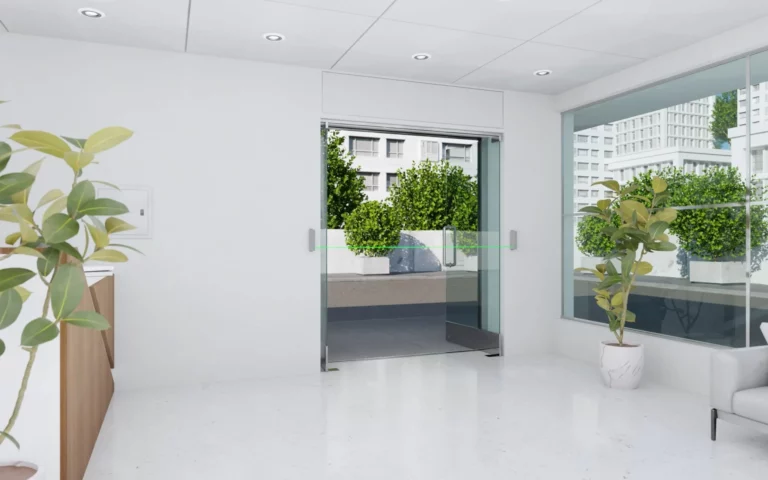
PEARL — wireless people counter Ours
Infrared beam pair on AA batteries over 2.4 GHz Wi-Fi. Peel-and-stick, minutes to install, in/out detection, mount at 54 in for adults or 24 in for everyone. Upwards of 98% accuracy on adults walking through normally, one at a time; covers doors up to 15 ft.
USD $499.95 · $449.95 with a 1-year plan · software from $0
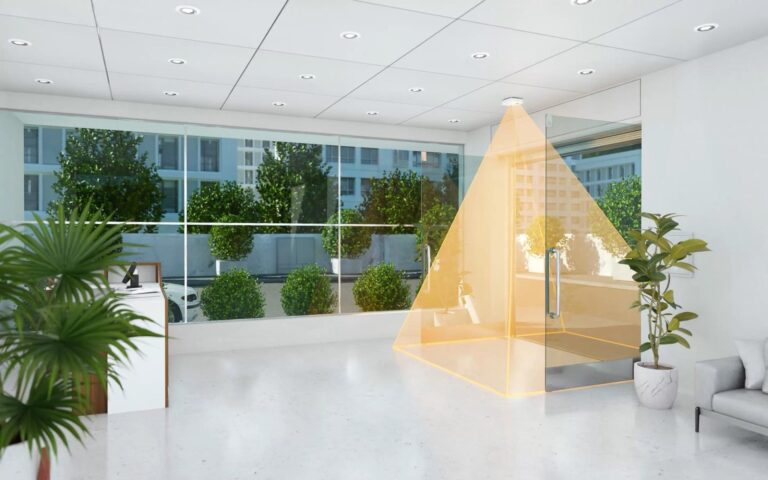
3D Scope II LC — 3D people counting camera Ours
Stereoscopic 3D with on-device AI and HDR. Separates groups, filters children and carts, U-turn logic, staff exclusion, wheelchairs, multiple count lines, video audit on request. 99% rated, 95% floor guaranteed for two years. One PoE cable; covers up to 6 × 5 m (19.7 × 16.4 ft).
USD $1,149.95 · $999.95 with a 1-year plan
~128 verified customer reviews across G2, Capterra and SourceForge (read them). Customers include City Furniture (a partner for more than ten years), The Body Shop Canada, La Vie en Rose, AM Retail Group and Furniture Mart USA (case studies).
Check our work
Sources
Claims about our own products come from our product pages, pricing page and help center, all linked in place. Claims about the market and the law come from the independent sources below, checked on September 9, 2026. No competitor is quoted or linked on this page; named comparisons live on the comparison page.
Accuracy and manual counting
- Diogenes, Greene-Roesel, Arnold & Ragland (2007), Pedestrian Counting Methods at Intersections: A Comparative Study, Transportation Research Record 2002, pp. 26–30 — manual sheet and clicker counts undercounted by 8–25% vs video
- SMS Storetraffic — how to audit your counter (30-minute video audits)
- Wikipedia — People counter (history; 1988 Meadowhall installation; generational accuracy figures)
Wages and cost
- U.S. Bureau of Labor Statistics — Retail Sales Workers, median $17.03/hour, May 2025
- Government of Canada — federal minimum wage $18.15, April 1, 2026
- SMS Storetraffic — nine systems compared (published prices, five-year totals, cable-run rates)
Conversion benchmarks and market
- Shopify — Retail Conversion Rate (updated March 2026; in-store benchmarks by format)
- SMS Storetraffic — How to understand and grow your retail store sales (12–20% first-count observation; Larstan Consulting survey of 117 chain managers)
- SMS Storetraffic — Why you need a customer counting system (closing ratios; the 2% to 7% apparel case)
- U.S. Census Bureau — Quarterly Retail E-Commerce Sales (e-commerce 17.1% of total retail sales, Q2 2026)
- ICSC & McKinsey & Company — Shopping in the Age of AI: Redefining Stores for a New Era (April 2026)
- Mordor Intelligence — People Counting System Market; Fortune Business Insights
Privacy and law
- FTC — Rite Aid banned from using AI facial recognition (2023)
- FTC — retail tracking firm settles charges it misled consumers about opt-out choices (2015)
- NBC News — Amazon sued over New York City biometric signage (2023)
- Biometric Update — Macy’s sued under BIPA over Clearview AI use (2020)
- NBC News — cameras that guess your age and gender come to store shelves (2019)
- City of Portland — ordinance banning face recognition by private entities in public spaces
- EU AI Act, Article 5 — prohibited practices; implementation timeline
- GDPR Recital 26 — anonymous information
- Privacy World — 2025 biometric privacy litigation review
- Torys — Quebec CAI on biometric information; Fasken — anonymization regulation under Law 25
- SMS Storetraffic — 3D Scope II data-privacy recommendations
- Apple — private Wi-Fi addresses (why Wi-Fi counting declined)
Installation and specifications
How this guide was made
SMS Storetraffic publishes and maintains this page. It consolidates and updates six articles we published between 2016 and 2024 — the technology series, the manual-versus-automated piece and two introductions — and adds what changed: edge AI, time-of-flight, the collapse of Wi-Fi counting, the EU AI Act, and 2026 prices. The author has worked in automated people counting since 2006. We sell two of the products mentioned and say so wherever they appear; where another technology or vendor is the better fit, the guide says that too. Corrections are welcome at our contact page and are applied at the next quarterly review.